
News
Evidentiary Standards in Cross-Border Intersection Disputes: Key Takeaways from the Landgericht Duisburg
1. Overview
On December 30, 2025, the Duisburg Regional Court (Landgericht Duisburg) handed down a judgment (Case No. 6 O 78/24) that sheds light on how German courts approach evidentiary questions in cross-border road traffic disputes. At the heart of the proceedings was a compensation claim arising from a collision in Belgium. The claimant, a German citizen, pursued the matter against the foreign vehicle's liability insurer, which was represented in Germany by a domestic claims settlement agent. The court grappled with questions of accident causation under Belgian law, contributory fault in the context of an alleged backing maneuver, and the admissibility of a write-off valuation and associated consequential losses in a German civil court.
2. Background and Disputed Facts
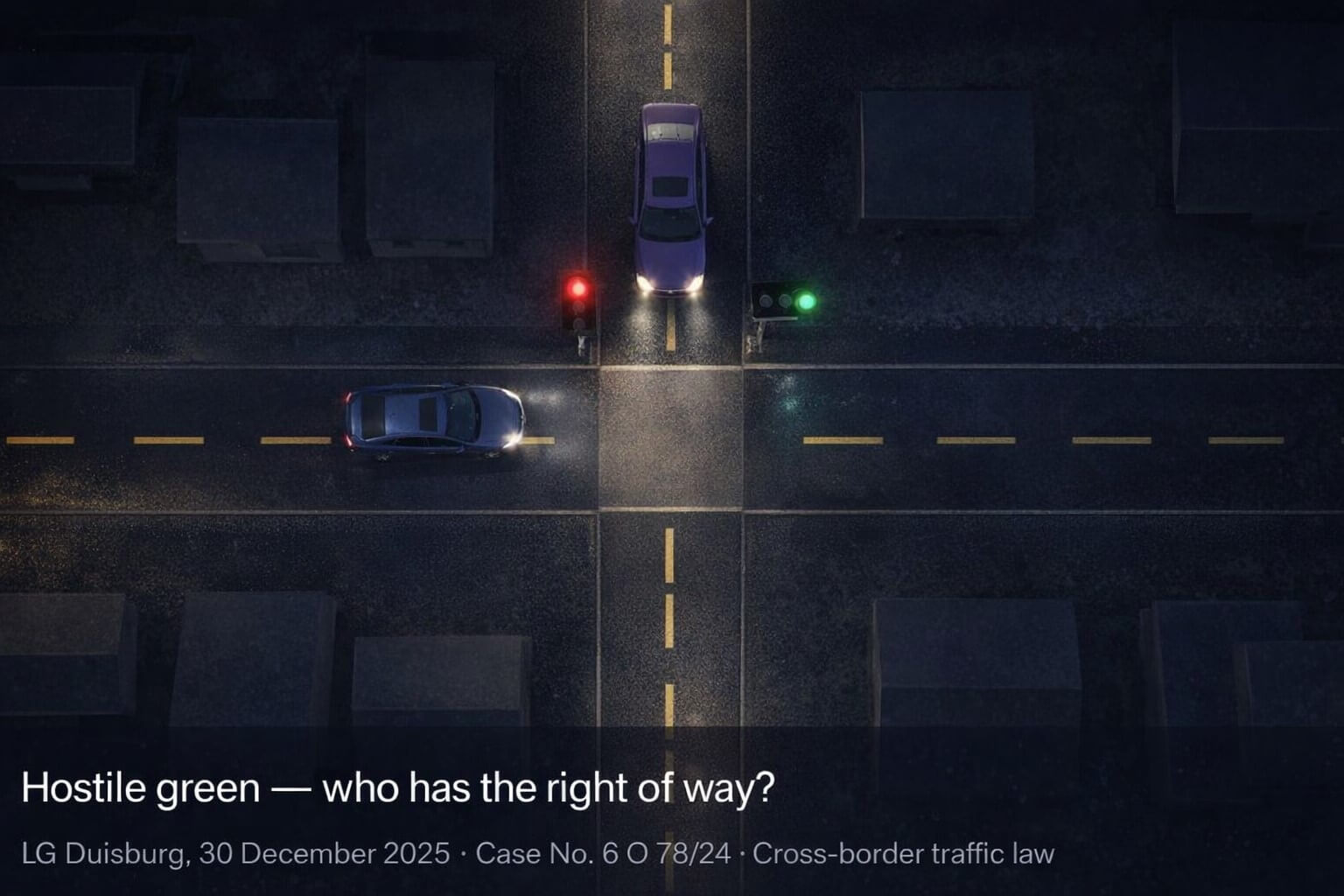
Both drivers claimed that they had crossed the intersection lawfully on a green light, each accusing the other of running a red light—a scenario commonly referred to in German traffic law as a "hostile green" (feindliches Grün). As no objective evidence was available to resolve the conflict, the court had to work exclusively from party statements and witness accounts.
The transnational nature of the dispute prompted the court to examine not only the applicable substantive law but also whether the cross-border element affected the standard or allocation of proof.
In cases involving disputed traffic light sequences, liability generally requires objective evidence, as prima facie evidence is insufficient.
The burden of proof remains with the plaintiff; the standards for the credibility of witness testimony are high.
3. Legal Questions Before the Court
The judgment addressed four interrelated legal questions:
How is the burden of proof allocated when both parties claim priority at a traffic-light-controlled intersection?
• What evidential threshold must a claimant meet to establish that they crossed on green?
• What criteria should a court use to evaluate conflicting and irreconcilable witness testimony?
Does the involvement of a foreign legal system alter the domestic rules on burden of proof?
4. Analysis of the Court's Reasoning
4.1 The Claimant's Evidential Burden
According to established German tort doctrine, the court ruled that a party seeking to prove liability must demonstrate each element upon which liability depends. In the context of a disputed traffic signal, this obligation extends to affirmatively demonstrating that the claimant entered the intersection with a green light. The mere occurrence of a collision does not carry any presumptive weight regarding signal compliance.
4.2 The "Hostile Green" Scenario
A mere assertion by the claimant that they had the right of way is insufficient when the other party contests the signal situation. To discharge the burden of proof, the claimant must present a coherent, consistent account supported by concrete details. Courts regularly reject such claims when the only evidence is the conflicting testimony of the parties involved, unsupported by technical data, such as traffic light switching records, or credible witnesses with no connection to either party.
German law provides the limited evidential tool of the Anscheinsbeweis, which is comparable to the common law doctrine of res ipsa loquitur. It allows a court to draw a rebuttable inference of fault when events follow a pattern typical of negligent conduct. However, this instrument presupposes a recognizable and undisputed factual sequence. Where the core facts are irreconcilably contested, as here, no such pattern can be identified, and the Anscheinsbeweis cannot be applied.
4.3 Credibility Assessment
Faced with conflicting testimony, the court applied widely accepted criteria for evaluating witness reliability based on the civil law principle of free assessment of evidence. The court examined the following in particular:
• The degree of specificity and internal coherence in each account;
• Whether unusual or complicating details had been mentioned spontaneously;
• The absence of formulaic or reconstructive elements suggesting a rehearsed narrative; and
• The overall impression of authenticity conveyed by the manner of giving evidence.
4.4 Effect of the Cross-Border Dimension
The court found that the international character of the proceedings did not affect the distribution of the evidential burden. The applicable foreign law was assessed and found to be substantively equivalent to German law on this point. A party's status as a foreign claimant or the fact that the accident occurred abroad provides no grounds to adjust or relax the standard of proof required before a German court.
5. Decision
Because the claimant failed to prove the alleged priority situation with the required degree of certainty under German civil procedure, the court dismissed the case.
6. Comparative Observations
6.1 Comparison with Common Law Systems (England and Wales/United States):
German tort law imposes a rigorous evidentiary burden on claimants in road traffic liability disputes, including those involving signal compliance. While the Anscheinsbeweis is the German counterpart to the res ipsa loquitur doctrine, which permits a rebuttable inference of negligence from a characteristic causal sequence, the two doctrines diverge in an important respect. Unlike res ipsa loquitur as applied in certain common law jurisdictions, the Anscheinsbeweis cannot be invoked when the sequence of the accident is genuinely disputed and no established pattern of events emerges. In such cases, the weight placed on credibility findings inevitably exceeds that accorded to inferential reasoning.
6.2 Comparison with Belgium, the Netherlands, and France
Belgian and Dutch law, like German law, are reluctant to infer liability solely from the physical dynamics of a collision. France, a common location for accidents involving German nationals or vehicles, requires separate consideration. French traffic accident litigation operates under a distinct framework.
Unlike the fault-based approaches in Germany and Belgium, traffic accident claims in France primarily fall under the Loi Badinter (Law No. 85-677 of July 5, 1985), a statute that introduced a no-fault compensation scheme for victims of motor vehicle accidents. Under this regime, liability largely arises without reference to fault, placing France at a considerable distance from the German and Belgian models. Practitioners advising clients on cross-border claims must carefully consider these differences, as the legal outcome of an otherwise comparable set of facts may differ substantially depending on which national system applies.
6.3 Practical Guidance for Cross-Border Claims Involving Germany
This decision provides several practical lessons for insurers, claims handlers, and legal advisers dealing with German-related cross-border traffic disputes.
Proactive evidence gathering, particularly preserving traffic signal switching data and technical records, is essential and should be initiated at the earliest possible stage.
Relying on witness testimony alone carries significant litigation risk because German courts apply demanding standards of credibility and consistency.
It would be a mistake to assume that a German court will moderate its evidentiary requirements simply because the claimant is based abroad or the accident occurred in another country.
7. Significance for International Practitioners
This ruling has broader relevance beyond the immediate dispute. It reaffirms the consistency with which German courts apply their domestic evidentiary framework, even in cross-border cases. It also illustrates the practical challenges that arise when objective evidence of signal status is unavailable. For those advising on or handling international traffic and motor insurance claims involving German jurisdiction, the decision is a clear reminder that procedural rigor and early evidence preservation are essential.
Source: Landgericht Duisburg, Judgment of December 30, 2025 - Case No. 6 O 78/24
See also: Oberlandesgericht Frankfurt, Judgment of October 9, 2012 - Case No. 22 U 109/11
Landgericht Essen, Judgement of February 25, 2025 - Case No. 6 O 296/18
Picture: AI-generated