
News
International traffic accident in Switzerland
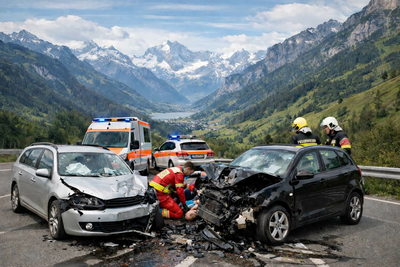
On June 5, 2025 (Ref. 3 U 65/24), the Higher Regional Court of Saarbrücken had to rule on liability following a traffic accident in Switzerland involving German parties. The plaintiff claimed damages after his vehicle was damaged in a rear-end collision on a Swiss motorway. The special feature of this case was its international aspect: the lawsuit was brought against the Swiss liability insurer of the other party involved in the accident before German courts.
Facts and course of proceedings
The plaintiff had his vehicle repaired after the accident for a net cost of €13,366.15 and claimed damages. The regional court partially upheld the claim, as it assumed fault on the part of the witness based on prima facie evidence. However, the court of appeal found that the accident could not be sufficiently clarified and therefore the witness's fault as the cause of the accident could not be proven beyond reasonable doubt. Both versions of the accident claimed by the parties remained possible, with no greater probability in favor of either version.
International jurisdiction of German courts
The Higher Regional Court affirmed the international jurisdiction of the German courts on the basis of the Lugano Convention (LugÜ 2007), which allows the injured party to bring a direct claim before the court of their place of residence (Art. 9, 11 LugÜ 2007).
According to these provisions, the injured party in a traffic accident can assert a direct claim under the applicable national law against the liability insurer based in a foreign country in the court of their place of residence.
Applicable law: Rome II Regulation and conflict of laws
With regard to the applicable law, the court clarified that, pursuant to Art. 4(1) of the Rome II Regulation, the law of the place of the accident, in this case Swiss law, is decisive – regardless of the fact that Switzerland is not a member state of the EU.
The provision applies because the claim arises from a traffic accident that occurred after January 11, 2009.
Substantive liability under Swiss law
In substantive law, the Swiss liability system differed significantly from the German system: According to Art. 61 (2) of the Swiss Road Traffic Act (SVG), the owner of a vehicle is liable for property damage caused to another owner only in cases of proven fault, not on the basis of mere operational risk as under German law (§ 7 StVG).
In the specific case, the Court of Appeal was unable to establish any fault on the part of the vehicle insured by the defendant that caused the accident.
Differences from German strict liability
The ruling emphasizes that, in contrast to German strict liability under § 7 StVG, which does not rely on fault, Swiss law requires proof of fault.
Prima facie evidence of fault based on a rear-end collision was considered to have been rebutted, as a different course of events was seriously considered.
Outcome and practical significance
In the absence of proof of fault, the Higher Regional Court dismissed the action.
The ruling clarifies the practical implications of international conflict of laws rules on the allocation of liability and illustrates the differences between national liability systems in traffic accidents with a foreign connection.
Picture: AI generated