
News
Same Target, Twenty-Seven Rulebooks: Europe Tightens the Screws on Cyclists and E-Scooter Riders
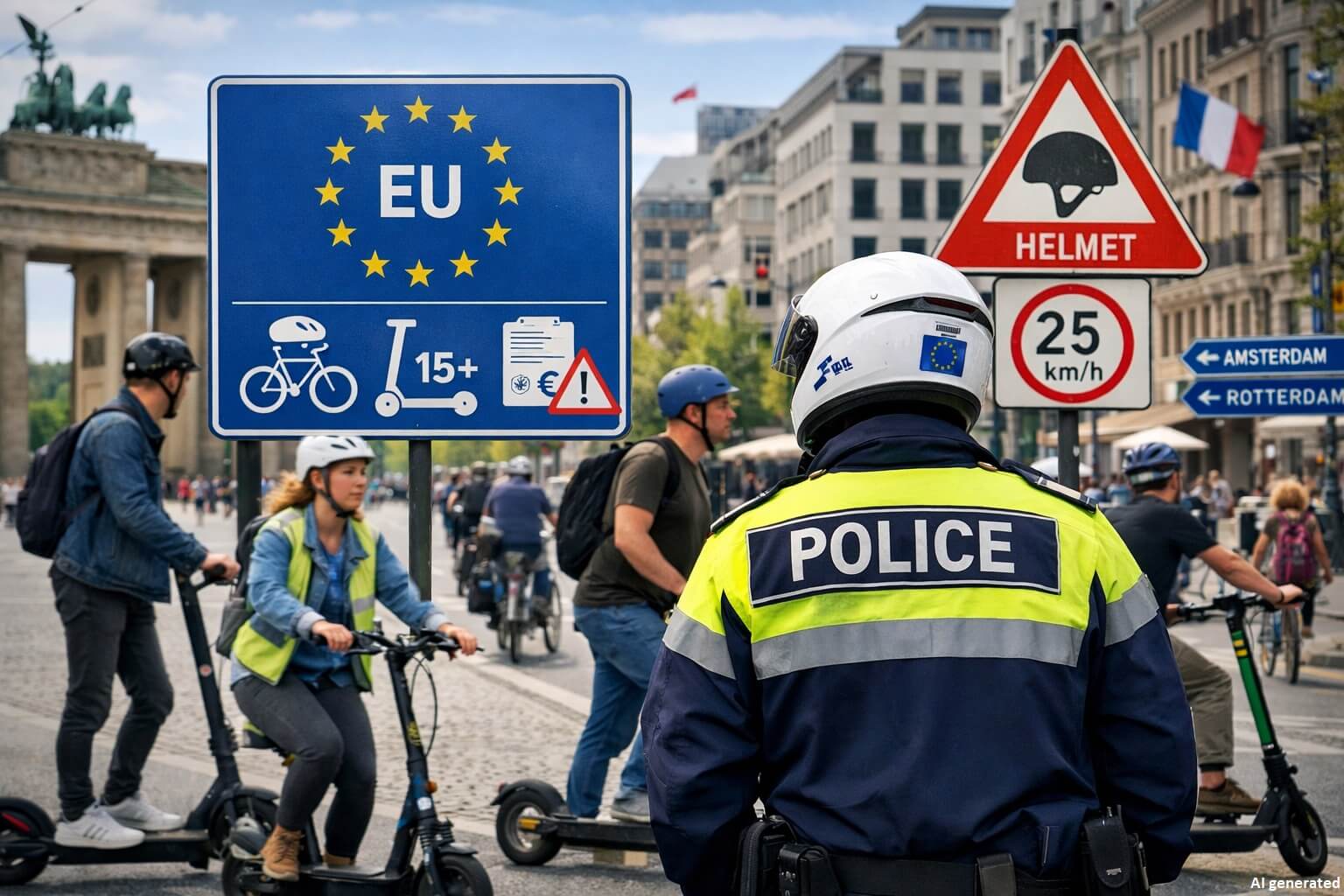
The EU vowed to halve road deaths between 2020 and 2030. At the halfway mark it is far off track — and the people now in the regulatory spotlight are the ones least protected in a crash.
Around 19,500 people died on EU roads in 2025, barely 2% fewer than the year before and only 15% down on the 2019 baseline, where a 31% cut was needed to stay on course. Those are the headline numbers from the European Transport Safety Council’s 20th Road Safety Performance Index, published on 23 June 2026. With cars themselves getting safer, the casualty figures are increasingly concentrated among pedestrians, cyclists and the riders of e-scooters and other light electric vehicles.
Governments have noticed. Across the continent the policy response is converging on the same set of tools — helmets, minimum ages, compulsory insurance, lights and high-visibility gear — while the detail diverges sharply from one country to the next.
Spain sets the latest marker
On 23 June 2026 the Spanish Council of Ministers approved a reform of the General Traffic Regulations that, from 1 October 2026, makes helmets compulsory for e-scooter riders nationwide, sets a minimum riding age of 15, requires lights to stay on, and mandates reflective gear at night. It also strips away the helmet exemption for cyclists on interurban roads and writes the “vulnerable road user” into Spanish law for the first time. Breaches are 200-euro offences.
Italy went earlier, and harder
Since 14 December 2024, every e-scooter rider in Italy — not just minors — must wear a helmet. Through 2026 private scooters are also being pulled into an identification-plate and third-party-insurance regime, and they are barred from roads outside built-up areas.
France: age limits yes, helmets (still) optional
France has set a minimum age of 14 since September 2023, caps scooters at 25 km/h and already requires liability insurance — but stops short of a helmet mandate for adults in town. A bill tabled in September 2025 would change that, extending compulsory helmets to all cyclists and scooter riders, cities included.
Germany: insured, but bare-headed
Germany requires every e-scooter to carry an insurance sticker, and riding without one is a criminal matter — yet it imposes no helmet duty at all: not for scooters, not for cyclists, not even for standard pedelecs.
The Netherlands: a cycling nation going backwards
The country that taught the world to cycle recorded 759 road deaths in 2025, its worst year since 2007, with cyclists the largest group of victims for the sixth year running and e-bikes driving much of the increase. A helmet requirement for under-18s on e-bikes and fatbikes is slated for 2027.
One goal, many rulebooks
The pattern is unmistakable: a single shared European target, national rulebooks that pull in the same direction, and a widening gap between them on the specifics. For a tourist on a rental scooter, a commuter crossing a border or an operator running a shared fleet, that gap is not academic. What is mandatory in Rome is merely recommended in Berlin; what insures you in Madrid may not follow you to Milan.
|
Practice tip Before you ride — or deploy a fleet — abroad, check the destination’s rules on helmets, minimum age, lights and insurance, and never assume your home-country cover travels with you. The thresholds differ by country and, increasingly, by city. |
Where these national regimes meet EU insurance law — and where they leave accident victims exposed — is the subject of our in-depth analysis in the members’ area.
|
Members’ area: A detailed legal and comparative analysis, is available in the members’ area. |