
News
Vehicle seizure instead of just a fine: A European comparison
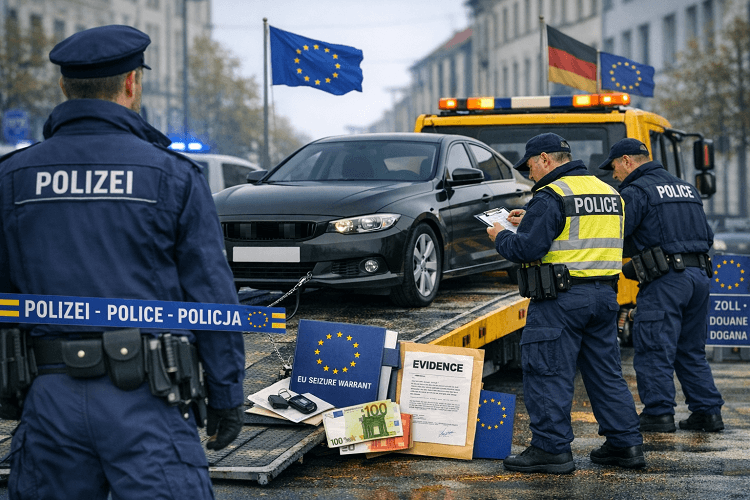
Austria
Drivers in Austria are increasingly speeding. The 2027 reform imposes significantly stricter penalties. Vehicles may be seized and auctioned off regardless of ownership. This means that the seriousness of the traffic offenses, rather than ownership, is most important. Austria is among the European states that consistently enforce severe penalties for traffic offenses.
Since 2024, a seizure after massive speeding is possible, but a more durable withdrawal was only possible if the driver is the sole owner at the same time. Especially, leased, rental, or company vehicles could be removed from traffic, but only for short-term and not final.
Ownership no longer provides protection
The reform follows a decision of the Austrian Constitutional Court of April 9, 2026 (Steiermark), in which the Court struck down the existing ownership-based restriction as unconstitutional. The legislature has responded by enacting a new framework that shifts the focus from ownership to the seriousness of the traffic violation. The court found the ownership restriction to be an unjustified distinction under the equality principle (Gleichheitssatz, Art. 7 B-VG) and the property guarantee (Art. 5 StGG / Art. 1 1. ZP EMRK).
The central conversion: In the future, what will matter is no longer who owns the vehicle, but the seriousness of the traffic violation. But this does not apply to stolen vehicles.
From a constitutional perspective, the new regulation is based on the principles of equality and property guarantee. A distinction based solely on ownership was deemed no longer objectively justified. At the same time, the legislator focuses on road safety as a matter of paramount public interest.
From speeding to impoundment
Nevertheless, seizures target specific assets and are carried out through a legal process. A vehicle may be impounded if the speed limit is exceeded by more than 90 km/h outside built-up areas or 80 km/h within built-up areas. For repeat offenses, the thresholds are 70 km/h within built-up areas and 60 km/h outside built-up areas.
The procedure is precisely structured: First, the vehicle is provisionally impounded for up to 14 days. During this time, the court reviews whether to authorize the final seizure. If the court approves, the vehicle will be auctioned off. If not, the driver faces disqualification from driving and a fine.
The purpose is to stop very dangerous traffic offenses from happening. Austria is not an exception to the rise; it is part of a European trend. In cases of serious traffic offenses, more and more countries are using the most severe measure: seizing and auctioning vehicles.
Germany: The seizure between criminal law and prevention
In Germany, seizures frequently occur during illegal motor races (§ 315d StGB).
First, the vehicle is seized as evidence (§§ 94 I, II StPO) and may later be permanently seized. Under § 315f StGB, this also applies to vehicles owned by others, such as leased vehicles.
Provisional seizure under Section 111b of the Code of Criminal Procedure (StPO) is only permissible if the factual and legal requirements for subsequent forfeiture are met, and if the measure is proportionate. Forfeiture is only possible in cases of criminal offences, not administrative offences. In particular, extreme speeding, driving without a licence (§ 21 StVG) or without insurance (§ 6 I PflVG) can result in permanent seizure, in accordance with the principle of proportionality.
France
French courts have long had the power to permanently strip drivers of their vehicles following serious traffic offences — confiscation being one of several sanctions available alongside fines and licence withdrawal. The legal foundation for this lies in the Code de la Route, most recently tightened by the law of 9 July 2025 on road homicide and road violence, brought into force through Decree No. 2025-1269 of 22 December 2025.
Since 29 December 2025, any driver caught exceeding the speed limit by 50 km/h or more faces criminal rather than merely administrative proceedings. The offence now carries a prison sentence of up to three months, a fine of up to €3,750, automatic loss of six licence points, and suspension for up to three years — with vehicle confiscation an additional sanction the court may impose for up to three years, alongside a potential five-year driving ban and a mandatory road safety course.
Confiscation is not applied mechanically. Even where the Code de la Route provides for it as a mandatory penalty, judges retain the discretion to waive it — provided they give specific reasons, for example where the vehicle is indispensable to the offender's livelihood.
Netherlands
The Dutch system draws a firm line between minor and serious traffic offences. Minor traffic offences, including most speeding violations, are handled under administrative law via the Wet Mulder (Mulder Act). The court is not involved — offenders simply receive a penalty notice from the Central Judicial Collection Agency (CJIB).
For minor offences, drivers who disagree with the penalty may appeal to the Public Prosecutions Service (Openbaar Ministerie).
Vehicle confiscation as a direct consequence of speeding is not part of the standard Dutch enforcement framework.
Switzerland: Consequence within strict proportionality
Switzerland relies on a complex interplay between the Criminal Code (Art. 69 StGB) and the Road Traffic Act (Art. 90 III, IV, 90a SVG).
In exceptional cases, vehicle seizure from third parties is possible under Art. 90a SVG. Due to the guarantee of property (Art. 26 BV), a proportionality assessment is necessary.
This procedure is governed by Art. 263 I d StPO. In addition, it assumes a concrete suspicion. In extreme cases (e.g., 2014: „Gotthard-speeder“), in addition to terms of imprisonment, a seizure and auction of the vehicle may be imposed.
Denmark: zero consideration for property
This country applies strict rules under the „Vanvidsbilisme“ law for extreme cases. In particular, when exceeding the speed limit by more than 100 km/h, doubling the maximum speed, or driving over 200 km/h.
Nevertheless, vehicles may be seized if alcohol levels exceed 2 per mille and cause personal injury. Ownership is not significant. Therefore, this also includes leased, company-owned, and foreign vehicles. This is demonstrated by the fact that several hundred vehicles have already been seized in practice.
Poland: strict rules, little scope
Since 2024, the seizure procedures have been tightened. This occurs at a blood alcohol concentration of 1,5 per mille or 0,5 per mille with an accident causation. In addition, repeated alcohol-related driving, hit and run, or violations of driving bans have to be observed. In total, the court can desist from seizure in exceptional cases, but a strict, standardized system of penalties prevails.
Italy: No property, no seizure
In Italy, vehicle seizures do not depend solely on ownership. Under the Codice della Strada (Highway Code), there are several grounds for seizure, including lack of insurance (Article 193), registration or technical irregularities (Articles 93 and 97), and alcohol or drug-related offences (Articles 186 and 187). The overarching framework for administrative seizure and confiscation is governed by Article 213 of the Codice della Strada.
When it comes to alcohol and drugs, authorities may seize a vehicle if a driver exceeds statutory blood alcohol thresholds or is found under the influence of narcotics. Very high BAC levels or repeat offences can make confiscation mandatory, and this consequence can apply whether or not the driver is the vehicle’s owner
Ownership matters, but only to a limited extent. Administrative seizure is vehicle based, not person based: a car can be impounded even when the registered owner was not driving. After seizure, the owner is usually named custodian and must ensure the vehicle is not used; failure to comply exposes the owner to fines, temporary licence suspension and possible confiscation. Courts will consider the owner’s knowledge and conduct in confiscation proceedings, but ownership alone does not automatically prevent confiscation.
Helmet rules and ECE Regulation 22
Italy requires motorcyclists and passengers to wear a properly homologated helmet. That means the helmet must meet the applicable European standard (ECE Regulation 22) and carry the correct E mark. Wearing a helmet that does not meet this standard is treated like not wearing a legal helmet and is penalized.
If police find a non homologated helmet, one can expect an administrative fine and the helmet itself may be seized and confiscated. Because a helmet is the single most effective protective device for riders — there is no crumple zone on a motorcycle — authorities take non compliance seriously. Using a non compliant helmet can also complicate insurance claims after an accident.
Can the vehicle be seized because of a bad helmet?
Yes — a non homologated helmet can lead to penalties that include temporary measures against the vehicle. In practice, this may mean an administrative immobilisation (a temporary vehicle stop) while the sanction is in force. Repeated or aggravated violations increase the risk of stronger measures. Nonetheless: Italian law (Art. 171 CdS) provides for fermo amministrativo of the vehicle as a possible sanction, but it is not automatic or universally applied.
Overall, the Italian vehicle seizure system is deliberately strict: seizure can be triggered on multiple grounds under the Codice della Strada, ownership provides limited protection and confiscation is frequently mandatory.
Conclusion
The European comparisons show a clear direction: Seizing vehicles is central to traffic safety.
Austria is aligning with this trend. Starting in 2027, the main focus will shift from who owns the vehicle to the dangerousness of the driver’s behavior.
Road safety takes precedence over property interests.
Sources
Austria
https://www.vfgh.gv.at/medien/Raser-Beschlagnahmung-KFZ.de.php https://www.adac.de/verkehr/recht/verkehrsvorschriften-ausland/auto-beschlagnahmt/
Germany
Regional Court of Gera, Order of September 5, 2025 - 1 QS 280/25
Higher Regional Court of Frankfurt – Case No.: 5/31 QS 15/22 - Order of August 2, 2022
France
https://www.service-public.gouv.fr/particuliers/vosdroits/F21887?lang=en
Netherlands
Appealing against a traffic penalty | Mobility, public transport and road safety | Government.nl
Switzerland:
https://kd3.ch/wp-content/uploads/2021/11/forumpoenale_einziehung-von-fahrzeugen_thomet.pdf
„Gotthard-Raser“: https://www.beck-aktuell.de/heute-im-recht/rechtsprechung/gotthard-raser-nun-im-gefaengnis-2018-10-16
Danmark
Tre år efter stramning mod vanvidskørsel: Næsten 3.000 køretøjer beslaglagt | Justitsministeriet
Italy
Le sanzioni | Polizia di Stato
Sequestro veicoli | Prefettura - Ufficio Territoriale del Governo di Novara
Sanzioni per chi circola senza casco: multa, punti e fermo del veicolo | Assicurazione.it
https://unece.org/transport/documents/2021/08/standards/un-regulation-no-22-rev5-06-series
Picture: AI generated
Too Fast to Keep: When Speeding Means Losing Your Car
In the European Union, a heavy foot on the accelerator can cost more than just a fine. In an increasing number of member states, driving significantly above the speed limit results in more than points on your license or a dent in your wallet - it can mean walking home without your car.
France, Italy, the Netherlands, and several other EU countries have introduced or tightened laws that allow — or even require — authorities to confiscate vehicles on the spot when drivers exceed speed limits by a certain margin. The thresholds, procedures, and legal consequences vary. They can range from temporary confiscation to permanent forfeiture.