
News
ATFM Delays After C-108/26 RX: The Court of Justice Sets Aside a General Court Preliminary Ruling
On 25 July 2023 an aircraft scheduled to fly from Katowice to Izmir was given a departure slot of 16:30 UTC. The slot resulted from an air traffic flow management (ATFM) regulation restricting capacity in the airspace over Hungary and Romania because of adverse weather. The flight arrived 1 hour 12 minutes late. In Izmir the same aircraft developed a technical fault that took 2 hours 8 minutes to repair, and the return flight to Warsaw landed more than three hours behind schedule.
A passenger assigned her claim for EUR 400 under Regulation (EC) No 261/2004 to a claims company. The carrier argued that the slot restriction constituted an extraordinary circumstance. Once the delay attributable to that restriction was deducted, the remaining delay fell below the three-hour threshold for compensation. The District Court for the City of Warsaw agreed on the arithmetic and asked whether an air traffic management (ATM) decision is, as such, an extraordinary circumstance.
Until 2024 that question would have gone to the Court of Justice of the European Union ("Court of Justice"). Since 1 October 2024, following the reform of the Statute of the Court of Justice, preliminary references concerning passenger compensation and assistance are heard by the General Court. The General Court answered on 21 January 2026 in Case T-134/25. Its view was that an ATM decision can be an extraordinary circumstance whatever the length of the delay and whatever the reason behind it, provided the carrier did not contribute to it. The decisive factor was the carrier's lack of involvement in the decision.
The First Advocate General proposed a review of that answer, the reviewing chamber opened one in March, and on 8 October 2026 the Second Chamber of the Court of Justice, with President Lenaerts sitting, found that the General Court's answers to the first two questions affected the unity and consistency of EU law. It set those answers aside and substituted its own. According to the Court's press release, this is the first review in which the Court of Justice has set aside answers given by the General Court in a preliminary-ruling procedure.
What the Court said
The judgment returns to the two-limb test that has governed Article 5(3) since Wallentin-Hermann in 2008. An event is extraordinary only if it is not inherent in the normal exercise of the carrier's activity and lies outside its actual control. The General Court had, in the Court's reading, merged the two limbs. Whether a decision is taken by a third party, and whether the carrier could influence it, goes to control. It says nothing about whether the event is part of ordinary operations.
On the first condition, the Court held that carriers encounter ATM decisions on a regular basis. Slot allocations, flow restrictions and rerouting form part of the ordinary operation of commercial air transport in congested European airspace. Treating every such decision as extraordinary, regardless of why it was taken, would extend the exemption well beyond what a strict reading of Article 5(3) allows.
What matters is the event that caused the decision. A volcanic ash cloud or fuel spilled on a runway can justify an exemption, and an ATFM regulation imposed because of them shares that character. A carrier relying on an ATM decision must therefore identify the event that prompted it, such as the weather behind a sector regulation, and prove that this event is itself extraordinary. Recital 15, which carriers have long cited, was read narrowly: it covers a decision affecting a particular aircraft on a particular day, and the legislature did not intend it to cover any decision taken in the management of air traffic irrespective of its reasons.
On weather, the Court distinguished two situations. Variable or difficult meteorological conditions form part of the normal exercise of a carrier's activity. Weather severe enough to prevent a flight from being operated safely and on schedule is a natural hazard outside the carrier's control. On the facts reported from Warsaw, the Court considered that the restrictions over Hungary and Romania appeared to meet both conditions, leaving the final assessment to the referring court.
The Court also confirmed how delays with several causes are calculated. Where a long delay has several causes, the portion attributable to the extraordinary circumstance is deducted from the total. An event does not need to cause three hours of delay on its own to count. The General Court's answers on knock-on effects across an aircraft's rotation were not reviewed and remain in place.
Why it matters beyond one claim
For airlines and their claims handlers the practical consequence is evidential. A reference to a Eurocontrol slot, or to the network manager's regulation of a sector, no longer carries the defence by itself. Operations and legal teams will need the underlying cause of each regulation, documented in a form a court can test. For claims companies the judgment closes off an argument that, had it been accepted, would have excluded compensation for every delay traceable to an ATM decision.
The institutional point may prove more durable. The 2024 transfer was designed to relieve the Court of Justice of high-volume, technical references. The review mechanism in Article 256(3) TFEU was designed as a safeguard for the unity and consistency of EU law. Within the first two years of the transfer it has already been used, in a field that produces a steady flow of references from national courts. The answers of the Court of Justice on the first two questions now bind every national court hearing a delay claim.
Weather and volcanic ash fit the Court's reasoning without difficulty. Regulations driven by air traffic control staffing shortages, sector capacity or industrial action by controllers raise harder questions, and those categories recur in every European summer schedule. The judgment does not say how they are to be classified.
The members' analysis sets out the review procedure, the Court's reasoning paragraph by paragraph, and how courts and enforcement bodies in Germany, Poland, the Netherlands, France, Spain and the United Kingdom are likely to handle air traffic management defences after C-108/26 RX: Read the full analysis in the IETL members' area
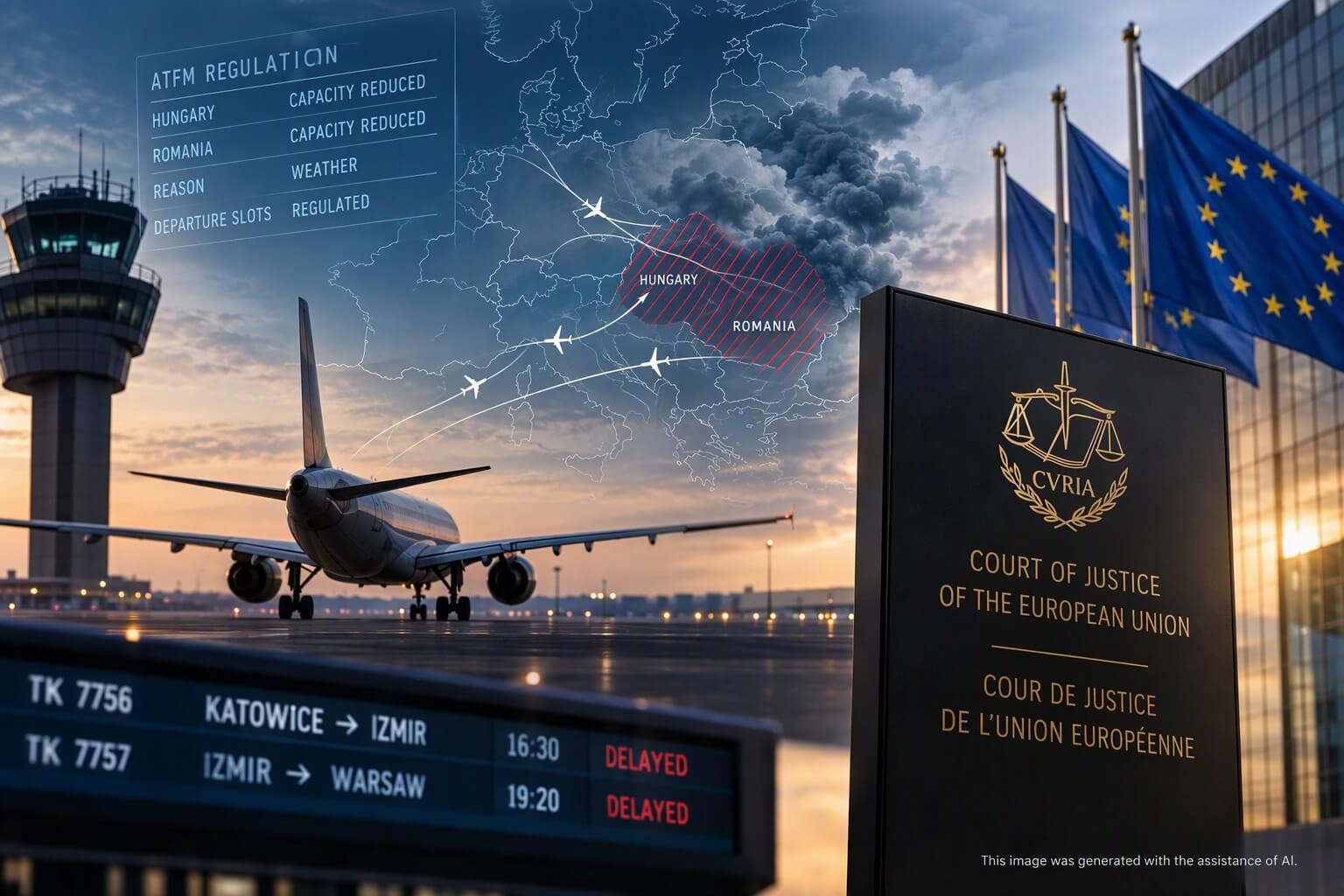
On 25 July 2023, an aircraft scheduled to fly from Katowice to Izmir was given a departure slot of 16:30 UTC. The slot resulted from an air traffic flow management (ATFM) regulation restricting capacity in the airspace over Hungary and Romania because of adverse weather. The flight arrived 1 hour 12 minutes late. In Izmir the same aircraft developed a technical fault that took 2 hours 8 minutes to repair, and the return flight to Warsaw landed more than three hours behind schedule.
A passenger assigned her claim for EUR 400 under Regulation (EC) No 261/2004 to a claims company. The carrier argued that the slot restriction constituted an extraordinary circumstance. Once the delay attributable to that restriction was deducted, the remaining delay fell below the three-hour threshold for compensation. The District Court for the City of Warsaw agreed on the arithmetic and asked whether an air traffic management (ATM) decision is, as such, an extraordinary circumstance.
Until 2024, that question would have gone to the Court of Justice of the European Union ("Court of Justice"). Since 1 October 2024, following the reform of the Statute of the Court of Justice, preliminary references concerning passenger compensation and assistance are heard by the General Court. The General Court answered on 21 January 2026 in Case T-134/25. Its view was that an ATM decision can be an extraordinary circumstance, whatever the length of the delay and whatever the reason behind it, provided the carrier did not contribute to it. The decisive factor was the carrier's lack of involvement in the decision.
That answer did not stand. The First Advocate General proposed a review; the reviewing chamber opened one in March, and on 8 October 2026, the Second Chamber of the Court of Justice, with President Lenaerts sitting, found that the General Court's answers to the first two questions affected the unity and consistency of EU law. It set those answers aside and substituted its own. According to the court's press release, this is the first review in which the Court of Justice has set aside answers given by the General Court in a preliminary-ruling procedure.
What the Court said
The judgment returns to the two-limb test that has governed Article 5(3) since Wallentin-Hermann in 2008. An event is extraordinary only if it is not inherent in the normal exercise of the carrier's activity and lies outside its actual control. The General Court had, in the Court's reading, merged the two limbs. Whether a decision is taken by a third party or whether the carrier could influence it goes to control. It says nothing about whether the event is part of ordinary operations.
On that question the court was blunt. Carriers encounter ATM decisions on a regular basis. Slot allocations, flow restrictions, and rerouting form part of the ordinary operation of commercial air transport in congested European airspace. Treating every such decision as extraordinary, regardless of why it was taken, would extend the exemption well beyond what a strict reading of Article 5(3) allows.
What matters is the event that caused the decision. A volcanic ash cloud or fuel spilled on a runway can justify an exemption, and an ATFM regulation imposed because of them shares that character. A carrier relying on an ATM decision must therefore identify the event that prompted it, such as the weather behind a sector regulation, and prove that this event is itself extraordinary. Recital 15, which carriers have long cited, was read narrowly: it covers a decision affecting a particular aircraft on a particular day, and the legislature did not intend it to cover any decision taken in the management of air traffic irrespective of its reasons.
Weather received a short treatment of its own. Variable or difficult meteorological conditions form part of the normal exercise of a carrier's activity. Weather severe enough to prevent a flight from being operated safely and on schedule is a natural hazard outside the carrier's control. On the facts reported from Warsaw, the Court considered that the restrictions over Hungary and Romania appeared to meet both conditions, leaving the final assessment to the referring court.
Finally, the Court confirmed the arithmetic. Where a long delay has several causes, the portion attributable to the extraordinary circumstance is deducted from the total. An event does not need to cause three hours of delay on its own to count. The General Court's answers on knock-on effects across an aircraft's rotation were not reviewed and remain in place.
Why it matters beyond one claim
For airlines and their claims handlers, the practical consequence is evidential. A reference to a Eurocontrol slot, or to the network manager's regulation of a sector, no longer carries the defence by itself. Operations and legal teams will need the underlying cause of each regulation, documented in a form a court can test. For claims companies the judgment closes off an argument that would have removed a large share of delay claims at a stroke.
The institutional point may prove more durable. The 2024 transfer was designed to relieve the Court of Justice of high-volume, technical references. The review mechanism in Article 256(3) TFEU was meant to be a safety valve, and many expected it to stay closed. Within the first two years of the transfer, it has already been used in a field that produces a steady flow of references from national courts. National courts now have a binding answer from the Court of Justice and a General Court that knows where the line is drawn.
What the judgment leaves open is the hard middle ground. Weather and volcanic ash are easy cases. Regulations driven by air traffic control staffing shortages, sector capacity, or industrial action by controllers are not, and it is in those categories that a large share of summer delays now sits.
The members' analysis sets out the review procedure, the Court's reasoning paragraph by paragraph, and how courts and enforcement bodies in Germany, Poland, the Netherlands, France, Spain, and the United Kingdom are likely to handle air traffic management defenses after C-108/26 RX: Read the full analysis in the IETL members' area