
News
Barrier-Free Europe? More Mobility with the New EU Parking Card – But Not Without Hurdles
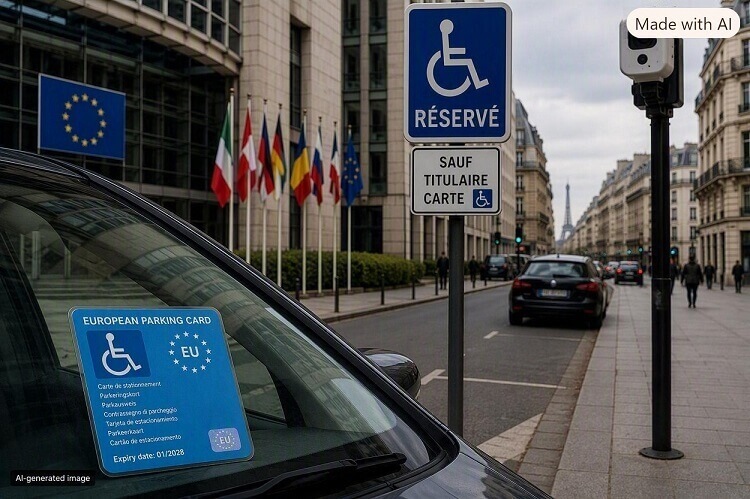
Free movement is one of the Union’s founding promises, and on paper it belongs to everyone. For travellers with disabilities the reality is more complicated. A parking card that is perfectly valid at home can trigger an automatic fine three countries away, and the road back is a long exchange of letters in a language the driver may not speak.
The card meant to help – the familiar blue EU parking card – has existed since 1998, when the Council recommended a common model (Recommendation 98/376/EC). It secured real privileges: parking on reserved wheelchair bays, free parking where residents with disabilities park free, and longer maximum times. But the conditions were left to each Member State. Germany, for example, issues the blue card only where the severe-disability pass carries the marks “aG” (exceptional walking impairment) or “Bl” (blind).
The high-tech pitfall: a digital flash, an analogue card
The privileges assume that a human being looks at the card. Increasingly, no one does. Cities across Europe now enforce parking and access with automatic number-plate recognition (ANPR) cameras. These read the licence plate and check it against a database – they cannot see the card on the dashboard. If the plate is not registered, the system issues a charge automatically, even though the entitlement is genuine. The consequence is an unjustified fine and a tedious, cross-border correspondence to undo it.
From 2028: one card for Europe
Directive (EU) 2024/2841 – in force since 4 December 2024 – sets out to close these gaps. It creates a standardised European Disability Card (EDC) and a European Parking Card (EPC), each carrying a QR code and, for the disability card, a digital version (Member States may add a digital parking card too). Member States must transpose the rules by 5 June 2027 and apply them from 5 June 2028; existing national parking cards are to be replaced by 5 December 2029.
What changes for travellers:
– EU-wide mutual recognition of disability status for short stays of up to three months, on the same terms as local holders;
– special conditions extend to a companion or personal assistant, and to assistance animals;
– public authorities and transport operators must make the applicable benefits and discounts transparent.
A principle that already works: the Eurokey
Cross-border barrier-free travel is not a utopia. The Eurokey demonstrates that practical cross-border standardisation can succeed when systems are accepted and interoperable.
Since 1986 the “Eurokey” (Euroschlüssel), created by the CBF Darmstadt, has opened accessible toilets – at motorway services, stations, pedestrian zones, museums and public buildings – with one standard key. Today that is around 12,000 locations in Germany, Austria, Switzerland and further European countries. Eligible holders (for instance the marks aG, B, H or Bl, or G with a degree of disability of at least 70, or a medical certificate for conditions such as MS, Crohn’s, ulcerative colitis or a stoma) are spared the need to prove their case at every door.
Members’ area: what happens on the ground
The tools are on the way, but the new European Disability Card and European Parking Card regime is not yet in place anywhere in the EU. Until the Directive is fully implemented and applied from 2028 onwards, travellers remain caught in a patchwork of national parking cards, disability-status systems and digital enforcement mechanisms that do not talk to each other.
In the members’ area we set out what actually happens at the roadside: France’s “forfait post-stationnement” trap and the LAPI cameras, and the exact steps to overturn a wrongful charge; Italy’s ZTL zones and the unified CUDE badge – and the Corte di Cassazione ruling that makes many of these fines unlawful; Germany’s disability markers; the wider European picture; and the awkward question of whether a wrongly issued foreign parking fine can be enforced across the border at all. We also examine what practical changes can realistically be expected once the new EU-wide cards begin to replace existing national systems from 2028 onwards.
→ Read the full analysis: “One Card for Europe? The Cross-Border Reality of Disabled Parking and Access – Germany, France, Italy and Beyond