
News
Digital Control Document: Spain Makes Paperless
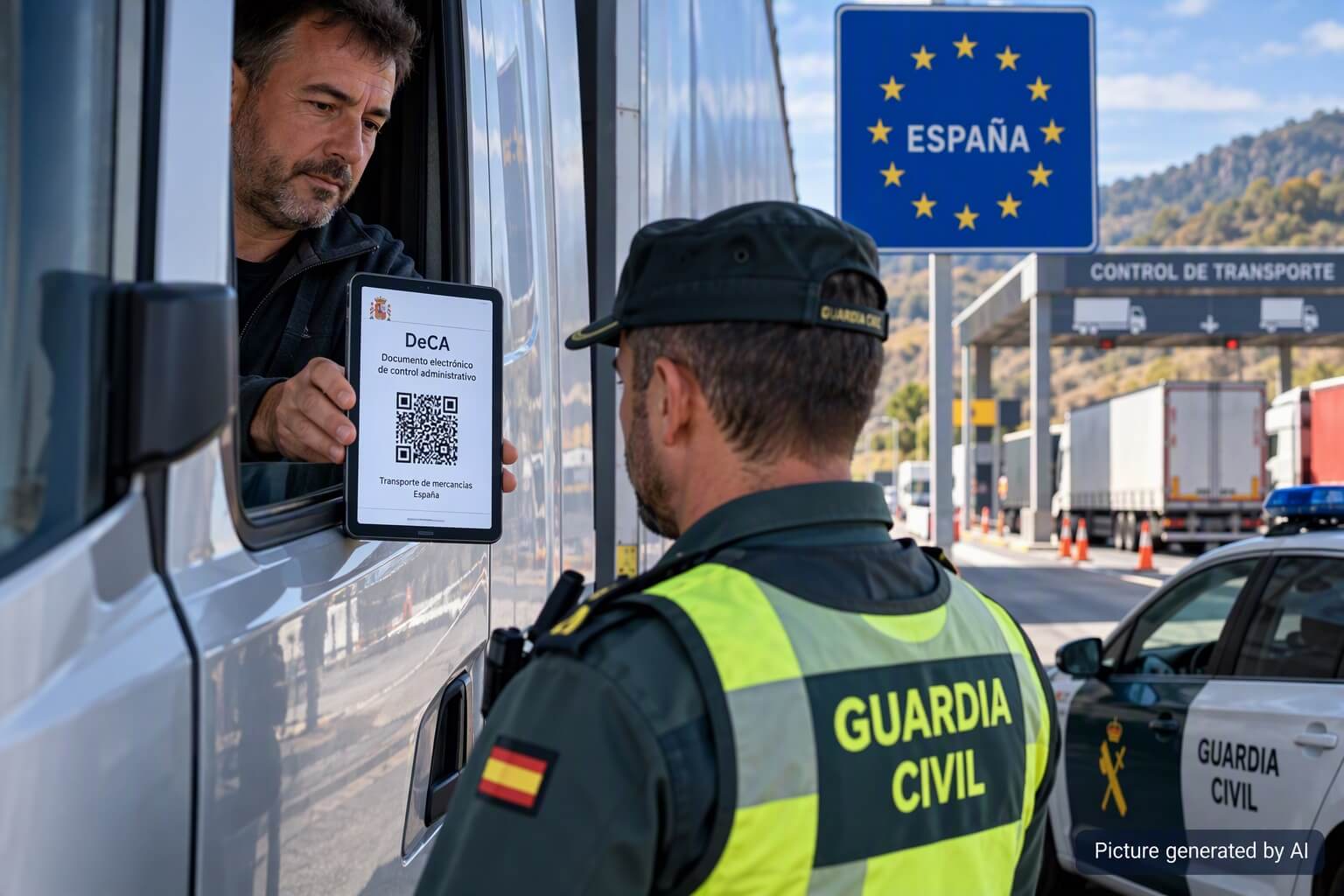
Since 5 October 2026, a driver stopped at a Guardia Civil checkpoint on a domestic Spanish run can no longer hand over a printed consignment record. Compliance is now demonstrated through a QR code. Scanning it calls up a PDF on a web server, the documento electrónico de control administrativo (DeCA). For public road haulage within Spain, the DeCA has become the mandatory form of the administrative control document, subject only to an alternative route via the EU's eFTI framework. The obligation applies irrespective of the Member State in which the carrier is established. A Lithuanian haulier running a cabotage load from Valencia to Zaragoza is bound in the same way as a Spanish one.
The control document itself is not new. Since Orden FOM/2861/2012, Spanish domestic hauliers have had to carry a record identifying the contractual shipper and the effective carrier, origin and destination, the nature and weight of the goods, the date and the vehicle registration. The Orden left the format free, and paper dominated. Transitional provision eight of Ley 9/2025 on Sustainable Mobility, in force since 5 December 2025, required the document to become digital ten months later. The Directorate-General for Road and Rail Transport set the technical rules in a resolution of 5 June 2026, published in the BOE on 12 June. Industry had barely four months to implement them. There is no transitional tolerance period, a point publicly criticised by the international hauliers' association ASTIC when the obligation took effect.
The scope follows the Spanish definition of domestic transport: both the place of loading and the place of unloading must be located in Spain. The resolution states expressly that cabotage falls within it. International journeys that only partly cross Spanish territory remain outside, because they use the documents prescribed by the conventions Spain has signed, in practice the CMR consignment note.
A carrier's existing PDF export will rarely meet the technical requirements unchanged:
• The DeCA must be a natively generated PDF of no more than 5 MB, built from structured data. Scans and photographed documents are invalid.
• It must exist before the journey starts. The date and time of creation, and of any modification, are stored as metadata of the PDF.
• An embedded QR code points to a unique HTTPS address. Calling that address must download the file directly, with no login, password or download button in between. The link must stay live for the whole journey and may be switched off seven days after the service ends.
• If data change en route, the operator amends the existing PDF, recording the reason and marking superseded entries, or issues a new PDF with a new code and keeps the original. Handwritten corrections on a printout carry no weight.
For a foreign undertaking performing cabotage, the practical questions are who generates the document and how it reaches the cab. The obligation rests on both the contractual shipper and the effective carrier. Either may create the DeCA, but both must keep the files for at least one year. Where the shipper produces the document, the carrier needs a way to download it throughout that period. A haulier that assumes its Spanish customer will "handle the paperwork" therefore still carries its own retention duty.
Generation can run through a transport management system, a commercial DeCA provider, or a free module the Ministry launched days before the deadline. The module requires prior self-registration but no digital certificate. Undertakings without a Spanish tax identification number may wish to verify the registration process before their first operation in Spain that falls under the DeCA regime.
The driver must receive a copy before departure, on a mobile device or on paper, with the QR code visible. During a roadside inspection, the driver presents the DeCA with its QR code, or failing that, the QR code alone. Several consignments may share one DeCA only where shipper and carrier are identical for all of them. A consignment note or an ADR transport document can serve as the DeCA if it contains every data field from Article 6 of the 2012 Orden and names the shipper and the effective carrier separately.
Foreign operators regularly ask whether the DeCA replaces their cabotage evidence. It does not. The evidence required under Article 8(3) of Regulation (EC) No 1072/2009, covering the incoming international carriage and each cabotage operation, remains necessary in full, and the DeCA is added to it. The eFTI route is the other source of confusion. The resolution allows the control data to be provided in the format of Regulation (EU) 2020/1056, in which case no DeCA in the prescribed form is required. From 9 July 2027, competent authorities across the EU must accept information made available through certified eFTI platforms, while use remains voluntary for businesses. How soon that route becomes workable in Spain depends on certified platforms being available.
How strictly inspectors will treat a missing or non-functioning code in the first weeks is not yet known. Spanish rules make both the contractual shipper and the effective carrier responsible for issuing the document, and both can be fined. Each journey without a valid DeCA counts as a separate infringement. The members' area analyses the legal framework and the sanctions regime under the Spanish Land Transport Act (LOTT), including the immobilisation of vehicles of non-resident carriers. It also compares the domestic transport-document requirements in France, Germany and the Netherlands and shows where those systems diverge from the Spanish model.