
News
Driving licence sanctions in November 2026: two Member States tighten, two reforms stall
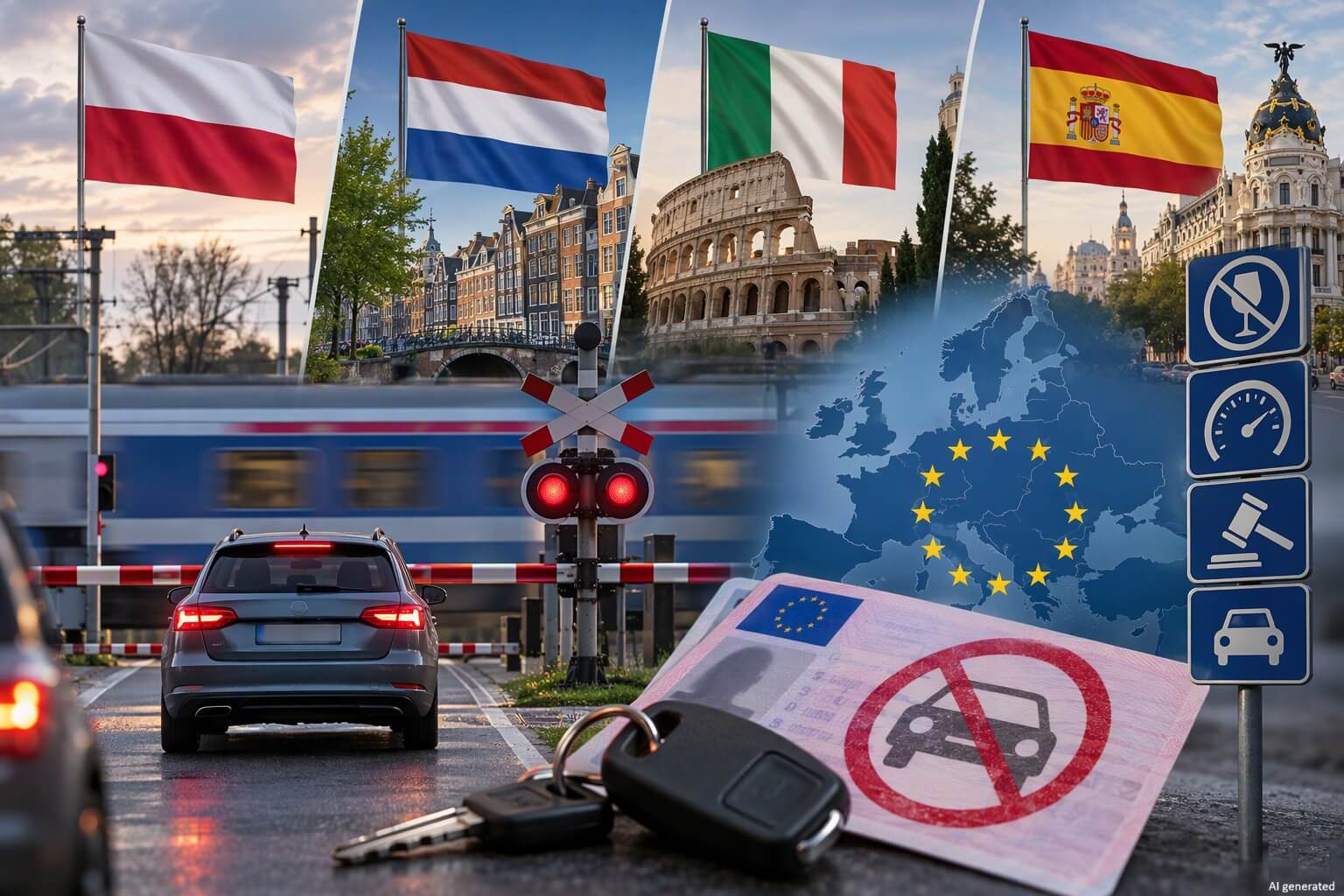
From Saturday 21 November 2026, a driver who moves onto a Polish level crossing in slow traffic, with the barriers up but no room to clear the tracks on the far side, loses the right to drive for three months. The district authority decides, without a court hearing. Poland is one of four Member States where licence sanctions moved this month. The Netherlands has completed its reform, while the reforms in Italy and Spain have stalled.
Poland: administrative licence retention for three months
The Act of 8 October 2026 amending the Road Traffic Act and certain other statutes was signed on 4 November and published on 6 November as item 1466 of the 2026 Journal of Laws. It enters into force fourteen days after publication. The prohibitions themselves are not new and already carried a fine of PLN 2,000 and 15 penalty points. The Act adds a three-month loss of the licence for four of them: driving around lowered barriers or half-barriers, entering while the barriers are closing or have not finished opening, passing a red or flashing red signal at the crossing, and entering when there is no room to continue beyond it. The police retain the licence against a receipt, and the starosta, head of the district administration, orders the retention by administrative decision.
A new Article 42 § 1b of the Criminal Code adds a mandatory driving ban of at least three years on conviction under Article 173 for causing a catastrophe in land, water or air traffic.
Netherlands: disqualification before final judgment
The Dutch Senate passed the Act improving the approach to driving under the influence (bill 36586) on 10 November without a vote. The companion bill on the alcohol meter (36585) followed on 17 November, with only the FVD and PvdD groups voting against.
The automatic recidivism scheme for serious traffic offences in the Road Traffic Act 1994 is abolished. In drink- and drug-driving cases the criminal court may, under conditions, order a disqualification to take effect at once, so that an appeal no longer suspends it. The court may also declare the licence invalid, which means a new driving test. An amendment adopted in the House of Representatives allows a disqualification for life or for up to thirty years where a driver under the influence causes a fatal accident and already has a final conviction for driving under the influence.
The alcohol meter, an ankle tag that detects alcohol in sweat, monitors compliance with an alcohol ban imposed by a court or prosecutor. The dates of entry into force will be set by royal decree and have not yet been announced.
Italy: the new Highway Code waits for the Council of State
On 13 October the Italian Council of Ministers approved, in preliminary examination, the draft legislative decree replacing the 1992 Highway Code. The Council of State’s advisory section for normative acts has suspended its opinion. Its interlocutory opinion in matter no. 1944/2026, adopted on 3 November and sent to the Government on 6 November, sets 25 November as the deadline for completing the file. The opinions of the Unified Conference and of the data protection authority are missing. The section also asks for clarification on the speeding fine tables, fines scaled to the offender’s means and automated driving. The draft applies the new rules from 1 January 2028.
Spain: two bills lapse with the legislature
Spain holds a general election on 29 November, and the dissolution of the Cortes has ended two road safety bills. One would have lowered the general alcohol limit from 0.5 to 0.2 g/l in blood (0.25 to 0.10 mg/l in breath). The other would have lowered by 10 km/h the excess speed at which Article 379(1) of the Criminal Code applies, to more than 50 km/h in built-up areas and more than 70 km/h elsewhere. A new Congress would have to reintroduce both bills. Until then the present limits apply, including 0.3 g/l in blood (0.15 mg/l in breath) for novice and professional drivers.
What operators should do now
Fleet managers with routes through Poland should brief drivers before 21 November, in particular on the rule that raised barriers do not permit entry when the exit is blocked, and plan for replacing a driver whose licence is retained on the road. Carriers and insurers with Dutch exposure should expect disqualifications to take effect earlier in the proceedings once the royal decree is published. In Italy and Spain, training continues on the rules currently in force.
Directive (EU) 2025/2206 will give Union-wide effect to disqualifications for drink- or drug-driving, speeding and traffic offences causing death or serious injury, provided the disqualification lasts longer than three months. The new Dutch disqualifications for driving under the influence fall within that scope. Level crossing offences are not among the offences listed, and the Polish retention lasts three months rather than longer.