
News
Europe has harmonised vehicle regulation. It has not harmonised liability.
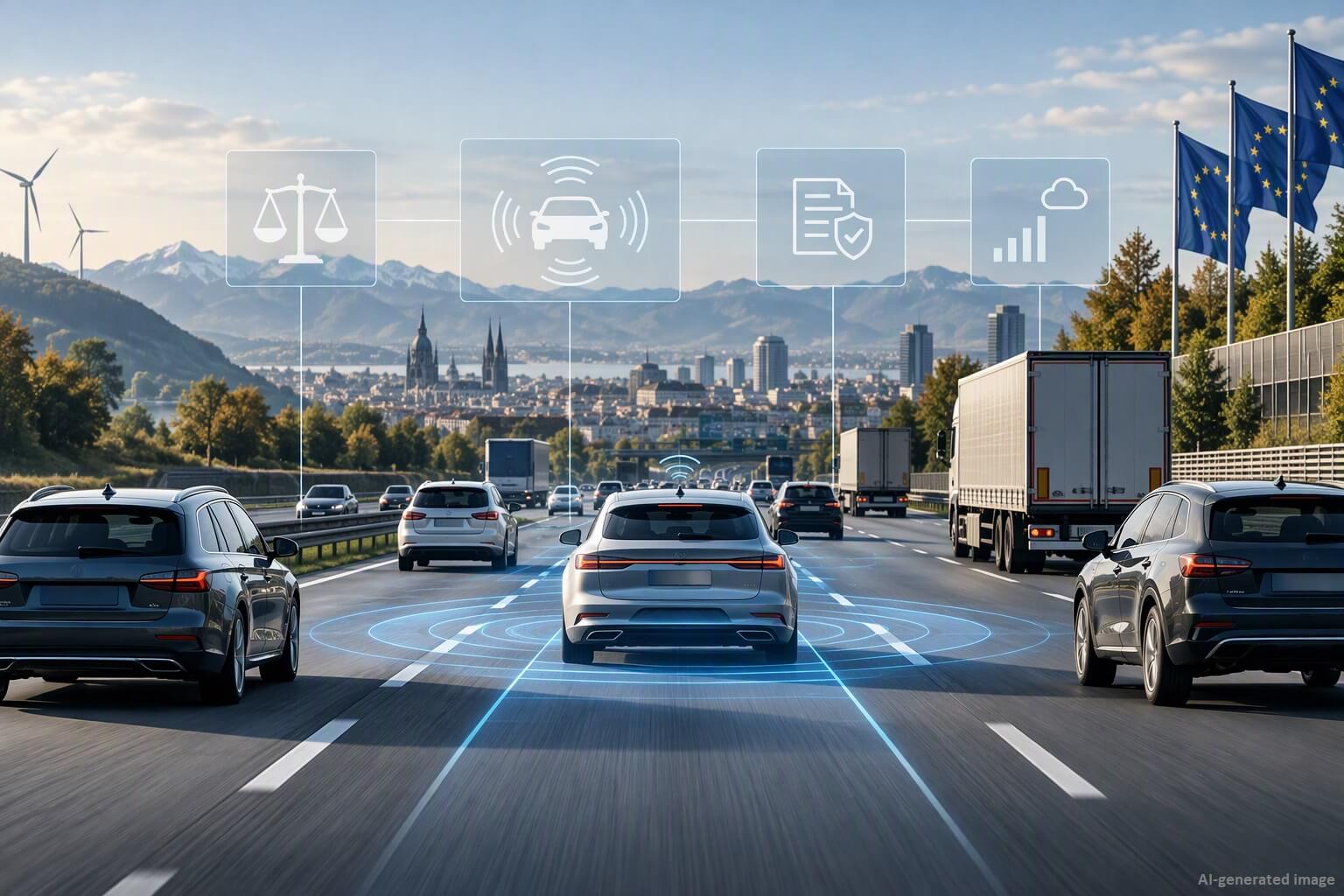
Automated driving functions are on European roads, and driverless services are next. The common assumption is that liability moves to the manufacturer once software steers. A review of eighteen European jurisdictions shows the opposite pattern in civil law: compensation still runs through the keeper and the compulsory motor insurer. Criminal responsibility, product liability and access to vehicle data are where the real changes are taking place, and they differ sharply from one country to the next.
On the A70 in Bavaria, a Tesla Model 3 covered at least eight kilometres while its driver slept. He had hung weights on the steering wheel and taped over the interior camera. When the case reached the Bayerisches Oberstes Landesgericht in October 2024, both the defence and the prosecution looked to the provisions of the German Road Traffic Act on automated driving. The court held that neither could rely on them. The car had a Level 2 system, the ordinary duties of a driver applied, and the fine of EUR 250 stood. Manipulation does not turn an assistance system into an automated one.
The case is minor. The question behind it is not. As higher levels of automation arrive, claimants, insurers and fleet operators want to know who answers for a collision when software was in control.
Germany has the most developed civil regime. The Straßenverkehrsgesetz has permitted automated driving functions since 2017 and driverless operation in approved areas, under a technical supervisor, since 2021. The legislator left the keeper's strict liability untouched, and a system failure does not count as force majeure. What did change were the liability caps, which double to EUR 10 million for personal injury and EUR 2 million for property damage where the damage results from such a function. The keeper must also release stored driving data to third parties who need it to pursue a claim.
The United Kingdom took a different path to a similar result for the injured party. Under the Automated and Electric Vehicles Act 2018, in force since April 2021, the insurer of a vehicle that was driving itself is directly liable and may then recover from whoever was responsible. The Automated Vehicles Act 2024 introduces the authorised self-driving entity, which carries regulatory duties and sanctions, and protects the user-in-charge from prosecution for the manner of driving. It does not make that entity the defendant in a civil claim. At the time of writing, the core of the 2024 Act is expected to apply from the second half of 2027.
France is often described as having shifted responsibility to the system. For criminal law that is accurate. Since 2021 the Code de la route has relieved the driver of criminal responsibility while the system exercises dynamic control, and in circumstances defined by the legislation that responsibility may pass to the manufacturer. Compensation for victims is a separate matter, governed by the 1985 Badinter law and compulsory motor insurance. A parallel ordinance gives insurers and accident investigators access to certain vehicle data.
Most other jurisdictions are at the testing stage or just beyond it. Switzerland's ordinance on automated driving has applied since March 2025 and allows a motorway pilot, automated parking and driverless vehicles on routes approved by the cantons, although the approvals granted so far still involve a person on board; keeper liability continues. Austria keeps the driver responsible under its testing ordinance and the keeper strictly liable under the EKHG. Poland enacted a permit regime for on-road research in 2025, with keeper liability and compulsory insurance built in. The Czech Republic has allowed EU-approved automated vehicles in ordinary traffic since January 2026 and added an unusual evidential rule: if the driver refuses the police access to the driving data, the system is presumed not to have been active. Italy, Belgium, Luxembourg, Spain, Hungary, Sweden, Norway, Denmark and Estonia rely on permits or exemptions for trials. Finland has prepared legislation that would move driver responsibility to the organisation operating the system.
The Netherlands shows a different pressure point. According to its published explanation, the RDW granted type approval in April 2026 to Tesla's "FSD (Supervised)" as a driver assistance system with the driver remaining responsible. Systems of this kind are likely to be what most claims handlers meet first, and they fall outside every automated-driving regime described above.
At EU level, the Commission withdrew its 2022 proposal for an AI Liability Directive in 2025. What remains is the revised Product Liability Directive. It treats software as a product, introduces court-ordered disclosure of evidence and presumptions of defect and causation, and applies to products placed on the market after 9 December 2026. In practice this opens a second front. The injured party can still claim against the motor insurer without proving any defect, while the insurer's recourse against the manufacturer becomes easier to pursue. Damage to property used exclusively for professional purposes stays outside the Directive, which matters for fleets.
Two gaps stand out. Outside Germany, the duties to record data in automated vehicles run almost everywhere to authorities, not to injured parties. And the Motor Insurance Directive still contains no rule on automated vehicles; the Commission must report on them by December 2030.
How far the second front reshapes claims practice will depend on the first cases involving active automated functions, and on whether the parties can see the data showing who, or what, was driving.
The full comparative analysis, with statutory references for all eighteen jurisdictions and a comparison table, is available in the members' area.