
News
Flashed, Parked, Paid: Austria’s Fines Go Nationwide – and Up – in 2027
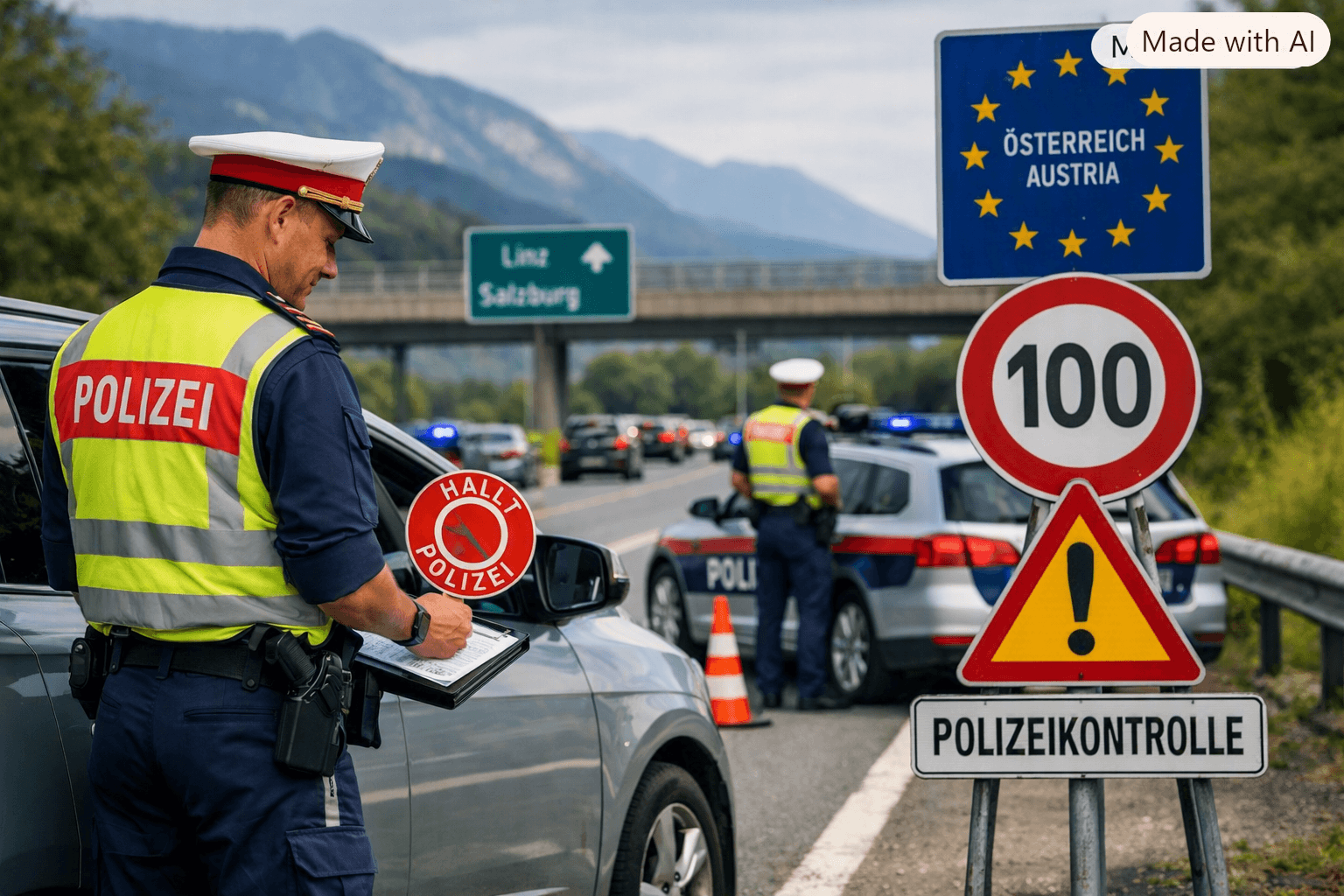
For years the price of a traffic slip in Austria depended on where it happened. Each federal province set its own fixed penalties, and for comparable offences the amounts could differ by up to fifty per cent from one Land to the next. That regional lottery is ending. Following a reform package sent for review in mid-June 2026, Austria will apply a single, nationwide schedule of on-the-spot and postal fines from 1 January 2027.
The headline is not just uniformity but level. For offences without a direct road-safety dimension – many parking breaches, for example – the new national figure is pegged to the highest amount previously charged anywhere in the country. Across the board, the change works out at an average increase of around fifty per cent.
What the everyday offences will cost
A handful of the new fixed amounts show where the reform bites hardest in daily driving:
|
Offence (fixed penalty) |
From 2027 |
|
Parking in a no-stopping/no-parking zone, or a missing parking disc in a short-stay zone |
€ 60 |
|
Entering a junction on a yellow light |
€ 70 |
|
Rolling through a stop sign, or 61 km/h in a 50 zone |
€ 80 |
|
Ignoring the keep-right rule, e.g. lane-hogging on the motorway |
€ 100 |
Source: ÖAMTC, based on the draft revised Anonymverfügung schedule.
Speeding is singled out
The reform reserves its sharpest edge for excessive speed, which the transport ministry blames for a rising share of serious crashes. The minimum penalty for exceeding a limit by more than 30 km/h climbs from €150 to €200. For the most serious band – more than 40 km/h over in town, or more than 50 km/h over on the open road – the floor rises to €400 and the ceiling of the range is lifted from €5,000 to €6,000. The official rationale: excessive speed was the main cause in roughly one in three fatal crashes, and the share of injury crashes linked to inappropriate speed rose from about 14 per cent in 2024 to over 16 per cent in 2025.
Austria is not acting in isolation. A string of European countries has sharpened its road-traffic penalties since 2024 – some through one-off reforms, others by annual indexation – and Austria’s move fits squarely within that wave.
And if you live abroad?
Here is the question every foreign driver eventually asks: can an Austrian fine actually follow me home to Munich, Milan or Maastricht? The short answer is yes – and the threshold at which it becomes worth Austria’s while to pursue you is lower than most drivers assume. The familiar “too small to chase” reflex is, for a large share of these new fines, simply wrong.
|
For members: the cross-border mechanics Our analysis breaks down how far an Austrian penalty really reaches, including the €70 EU enforcement threshold, how procedural costs can push smaller fines over this threshold, and the special Austria–Germany treaty that allows collection from fines as low as €25. It also covers the reach of the amended Cross-Border Enforcement Directive (EU) 2024/3237. It also explains what happens when an anonymous penalty is ignored and why 'criminal record' is the wrong phrase, as well as what is not exportable: Driving bans and licence points. Plus, there are takeaways for fleets and hauliers. The comparative picture completes it. Exactly where Austria’s 2027 tariff sits against the post-2024 fine reforms elsewhere in Europe, with the named jurisdictions and numbers, is reserved for the members’ analysis. |
Sources
ÖAMTC, „Ab 2027: Anonymverfügungen einheitlich und teurer" (15 July 2026).
Directive (EU) 2015/413, as amended by Directive (EU) 2024/3237; Council Framework Decision 2005/214/JHA.
Image: AI generated