
News
Make Way, But How? Europe’s Emergency Corridor Patchwork
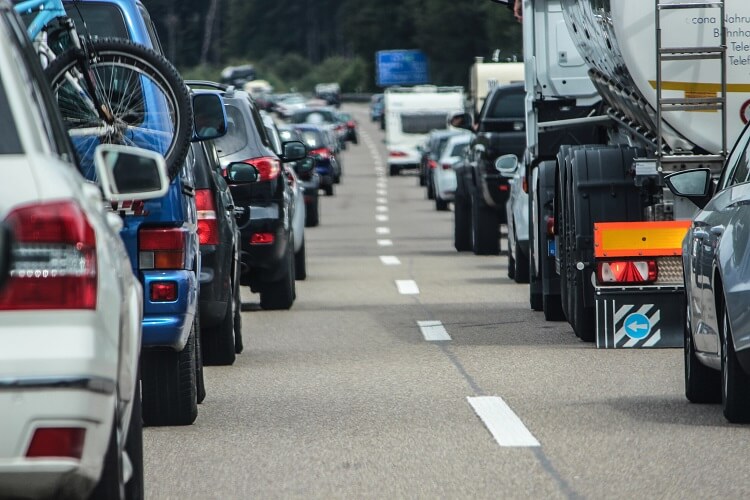
A queue builds up on a motorway. The driver in the left-hand lane moves to the left, while the other drivers move to the right, creating a gap in the middle. Forty kilometres further on, past a border post, this manoeuvre may be compulsory, pointless or even illegal.
The objective is the same in every European country: the emergency services must reach the scene, and every minute lost in traffic reduces the chances of survival. However, the legal technique for achieving this varies greatly from country to country. Europe runs two different models side by side, and the border between them does not follow any obvious pattern.
There is no one rule, just two models.
The first model is the precautionary corridor. Roughly a dozen states require drivers to open a lane before any blue lights appear. The trigger is the state of the traffic, not the arrival of an ambulance. Germany and Austria are the archetypes, and both are often misunderstood, even by the German motoring press. The duty does not start when traffic comes to a halt. It begins when traffic slows to walking pace. A driver who waits for traffic to come to a standstill has already missed the moment, both legally and practically.
The second model is the reactive duty to give way. Several major transit countries impose no advance corridor at all, instead relying on the general obligation to make room once a priority vehicle appears. France adds an additional measure to this, but it is designed to protect roadside workers rather than clear a route through traffic. One large neighbouring country has no corridor rule whatsoever and instead relies on the hard shoulder. Another member state is in the process of changing its approach, with a reform of its road traffic regulations that would adopt the continental corridor rule in its entirety.
Why is this an operator problem and not a tourist problem?
Three variables shift at the border. Where the corridor forms. What triggers the duty. The third is whether a driver is allowed to use the hard shoulder to make room. Neighbouring states take flatly opposite positions on the last point: in one, moving onto the hard shoulder to open the corridor is expressly permitted, whereas in the next it is a separate and more expensive offence than failing to form the corridor in the first place. A driver applying the rule they learned at home will sometimes open the gap in the wrong place and occasionally block the one local drivers are forming.
Once the vehicle has stopped, none of this can be corrected for a 16.5-metre combination. The position is decided in the seconds before the queue closes up, which is precisely when the driver is least likely to be thinking about comparative traffic law.
The part that has just changed
Until recently, this was a domestic enforcement question and a foreign fine was easily ignored. That assumption no longer holds. The revised cross-border enforcement directive has added failure to respect the rules on the creation and use of emergency corridors to the catalogue of offences for which member states exchange vehicle registration data and pursue non-resident drivers. Once national transposition is complete, a corridor offence committed in a foreign traffic jam will follow the vehicle home and the keeper will be the first person the authorities will ask. See Directive (EU) 2024/3237 amending Directive (EU) 2015/413.
This turns a question of driver courtesy into a compliance issue with a paper trail.
Members’ area
The full analysis, available in the members' area, names the jurisdictions and sets out the governing provision, trigger threshold, corridor geometry, hard-shoulder position and sanction for each of them in a comparative table.
It also covers:
- the states that have no corridor duty at all and what applies instead
- who is permitted to drive in the corridor and the reason why one member state has a structural conflict between its corridor rule and its filtering rule for motorcycles.
- the reform that will move a further member state from the reactive model to the precautionary one
- how a corridor fine is collected across a border;
- where the EUR 70 threshold applies;
- what cannot be exported at all.
- a driver briefing checklist for mixed-route fleets