
News
More safety, more control? Europe’s traffic law between assistance and intervention
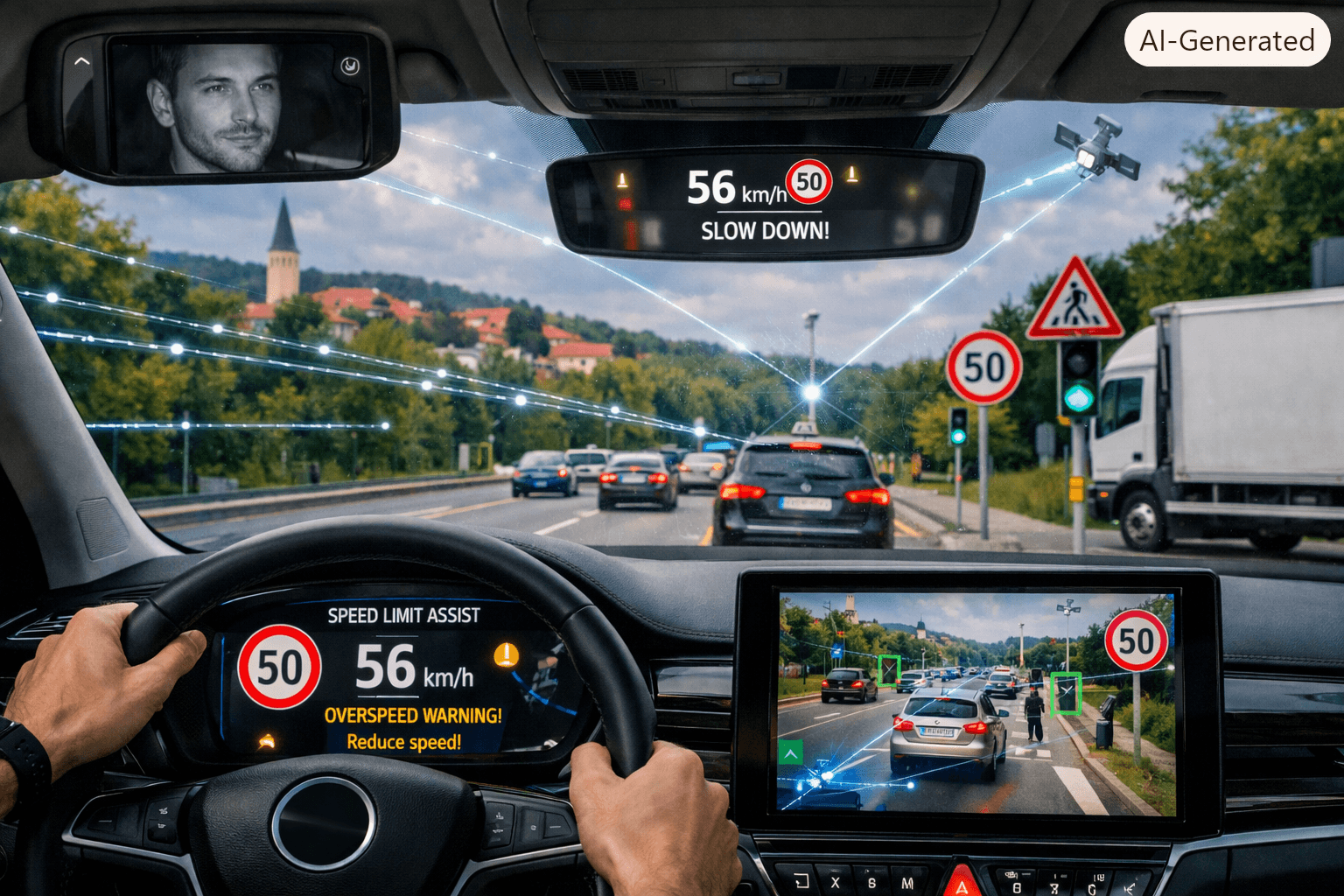
A widely reported claim that Brussels is preparing a satellite-based speed cap for 2030 does not survive contact with the legislative record. What has actually changed in 2026 is more consequential — and less visible.
A report in the British press claimed in July 2026 that the European Commission was preparing a satellite-based system to cap vehicle speed automatically from 2030. The story travelled fast across Europe. It is also, in its essential claim, not accurate.
Asked directly, a Commission spokesperson stated that the Commission is not examining any future version of Intelligent Speed Assistance involving a mandatory limitation of vehicle speed, and described the corresponding reports as incorrect. The original report cited no legislative proposal and no published draft, relying instead on anonymous sources; a further Commission spokesperson described the talks as purely exploratory. Publicly accessible documents of the Commission, the Parliament and the Council contain no proposal for a mandatory satellite- or geofencing-based speed limitation for passenger cars — a point that can be verified directly against EUR-Lex and the Legislative Observatory.
What already applies is narrower — and more interesting
Since July 2024, every newly registered passenger car and light commercial vehicle in the EU must be fitted with Intelligent Speed Assistance under Regulation (EU) 2019/2144 and Delegated Regulation (EU) 2021/1958. The system detects speed limits through traffic-sign recognition combined with digital map data and alerts the driver when the limit is exceeded. The harmonised requirement is a warning function only. Speed is not automatically capped, and the system must remain overridable and deactivable at all times.
That single design decision — warn, do not intervene — is what keeps the entire liability structure where it has always been: with the driver and the vehicle’s operator. Every debate about the next generation of ISA is therefore, in substance, a debate about moving that line.
And ISA is only one front
Since 7 July 2026 a camera has been pointing at the driver in every newly registered car in the EU. Italy switched off roughly a quarter of its speed cameras on 12 July 2026 and rewrote the ground rules for challenging a fine. A new EU product liability regime expressly covering software applies from 9 December 2026, and the revised cross-border enforcement directive must be transposed by 20 July 2027.
Four instruments, four different régimes, one common question: where does European law place the point of legal responsibility when the vehicle is doing part of the thinking?
→ Full analysis in the members’ area