
News
Neighbouring Container Transhipment Ports: Abu Qir and Damietta Added to the EU ETS and FuelEU Anti-Evasion Lists
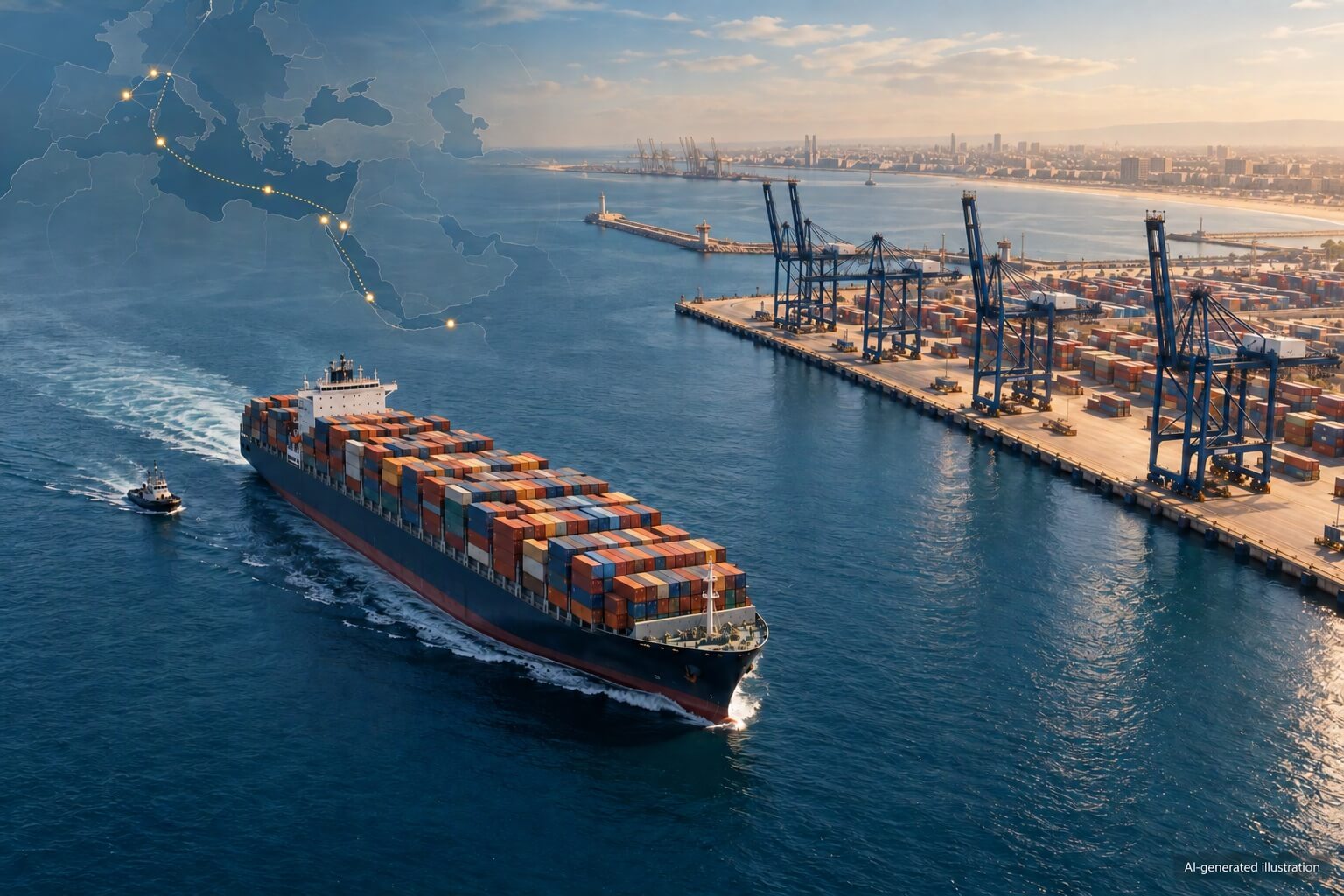
The Commission has added two Egyptian ports to the lists of neighbouring container transhipment ports under the EU ETS and FuelEU Maritime. From 10 December 2026, a stop at Abu Qir or Damietta no longer splits a voyage for regulatory purposes. The change affects how emissions are counted, how BIMCO charter clauses allocate the cost and whether the published reasons would withstand a legal challenge. It also raises an open question for insurers: the fines rules of the major P&I clubs do not expressly address ETS allowances or FuelEU penalties.
Two more Egyptian ports added
The EU has extended one of the anti-evasion mechanisms in its maritime climate legislation. From 10 December 2026, calls at the Egyptian ports of Abu Qir and Damietta no longer interrupt the voyage calculation for the purposes of the EU Emissions Trading System and FuelEU Maritime. For container operators, charterers, shippers and other cargo interests on the services concerned, that can mean higher ETS exposure and higher FuelEU compliance costs.
The legal basis is a pair of implementing regulations adopted on 19 November 2026 and published in the Official Journal the following day. Implementing Regulation (EU) 2026/2562 amends the ETS list in Implementing Regulation (EU) 2023/2297. Implementing Regulation (EU) 2026/2563 amends the FuelEU list in Implementing Regulation (EU) 2025/1127. Until now both lists named two ports: East Port Said, at the northern end of the Suez Canal, and Tanger Med, across the strait from Gibraltar. They now name four, three of them in Egypt.
The anti-evasion logic behind the list
Since 2024 the ETS has covered emissions from ships of 5,000 gross tonnage and above. Voyages between two ports in the European Economic Area count in full; voyages between an EEA port and a third-country port count at 50 %. The surrender obligation was phased in at 40 % of verified emissions for 2024 and 70 % for 2025, and reaches 100 % in respect of 2026 emissions. FuelEU Maritime, applicable since 1 January 2025, limits the greenhouse gas intensity of the energy used on board, starting with a 2 % reduction, and applies to half of the energy used on voyages to or from a third country.
Both regimes measure voyages between successive ports of call. Without a specific rule, operators could reduce their exposure by routing ships through large transhipment hubs just outside the Union. A ship arriving from Asia would then bring only the short final leg into the system, and only at 50 %.
Article 3ga(2) of Directive 2003/87/EC and Article 2(2) of Regulation (EU) 2023/1805 address that risk. A stop at a listed neighbouring container transhipment port does not count as a port of call. The Commission lists a port where it lies less than 300 nautical miles from a port under the jurisdiction of a Member State, where transhipment exceeded 65 % of its total container traffic in the most recent twelve-month period for which data are available, and where the third country does not effectively apply measures equivalent to the EU rules. Under FuelEU, the energy a container ship uses while stopped in such a port is reported as energy used at sea, as the Commission's FuelEU Maritime Q&A confirms.
For Abu Qir and Damietta, the recitals of the FuelEU amendment record each finding, including that Egypt applies no equivalent measures in either port. They disclose neither the actual transhipment percentages nor the underlying data on which the Commission relied.
What changes on 10 December
Calls at Abu Qir and Damietta remain permitted. What changes is the voyage calculation. A service calling at either port between Asia or the Gulf and a port in the Union no longer starts or ends a voyage there for ETS and FuelEU purposes. The voyage runs from the previous genuine port of call, so routes that were previously split for regulatory purposes are treated as one longer voyage, and a larger share of emissions and energy falls under the 50 % rule. Reported emissions per rotation rise, and with them the allowances to surrender and the FuelEU compliance balance.
Entry into force on 10 December 2026 lands three weeks before the 2027 reporting year, the first after the ETS phase-in has run its course. Monitoring plans and voyage reporting tools should reflect the extended list from that date. Time charterers who bear allowance costs under ETS clauses, and shippers whose freight contracts carry an EU ETS surcharge, will see the change in the next surcharge notices. Whether a particular surcharge accurately reflects the additional compliance cost depends on the contractual allocation and the underlying voyage data.
Charterparties and cover
For time charters, the standard BIMCO wording already allocates the cost; the listing changes the quantity being allocated. Under the ETS Emission Trading Scheme Allowances Clause for Time Charter Parties 2022, charterers "provide and pay for" the allowances corresponding to the vessel's emissions. Owners notify the previous month's emissions by the seventh day of each month, and charterers transfer the allowances within seven days of that notification. The FuelEU Maritime Clause for Time Charter Parties 2024 works through a surcharge: where the vessel's compliance balance is in deficit, charterers pay a sum equal to the FuelEU penalty expected for the month or voyage concerned.
Both clauses allow owners to suspend performance on five days' notice if charterers fail to transfer or pay, and under the ETS clause the vessel remains on hire during the suspension. A charter running across 10 December will see voyages via Abu Qir or Damietta counted differently before and after entry into force, within the same monthly statement. Where the parties disagree on the figures, the suspension right can turn an accounting difference into an operational one. Such disputes are charterparty disputes in the ordinary sense and will reach defence cover and the parties' lawyers in that form.
Whether the financial consequences can be passed to an insurer is a separate matter. The fines rules of the UK P&I Club, Skuld (Rule 19) and The Swedish Club (Rule 7, Section 6) in their 2026 editions do not expressly address ETS allowances or FuelEU penalties. The cost of allowances is a regulatory compliance cost rather than a fine. Whether a FuelEU penalty falls within the concept of a fine under those rules has not yet been tested.
Questions the list leaves open
Neither regulation states the transhipment percentages behind the new entries. An operator or carrier that disputes the 65 % finding therefore has little information in the Official Journal against which to verify the Commission's assessment. An action for annulment under the fourth paragraph of Article 263 TFEU is available against a regulatory act that is of direct concern to the applicant and entails no implementing measures. Whether a third-country port operator, or a line whose network is built around Damietta, meets that test has not been decided, and the time limit runs from publication on 20 November.
The list is reviewed every two years. With three of its four entries now Egyptian, carriers and terminal operators will be watching whether other transhipment hubs within 300 nautical miles of an EU port are examined in the next cycle. The equivalence condition also works in reverse: if Egypt applied carbon pricing measures of its own in these ports, the basis for listing them would fall away. The IMO's extraordinary session on the Net-Zero Framework in early December may further influence the discussion of what counts as an equivalent measure for ETS and FuelEU purposes.