
News
October Deadlines: Tolls, Control Documents and Data Duties
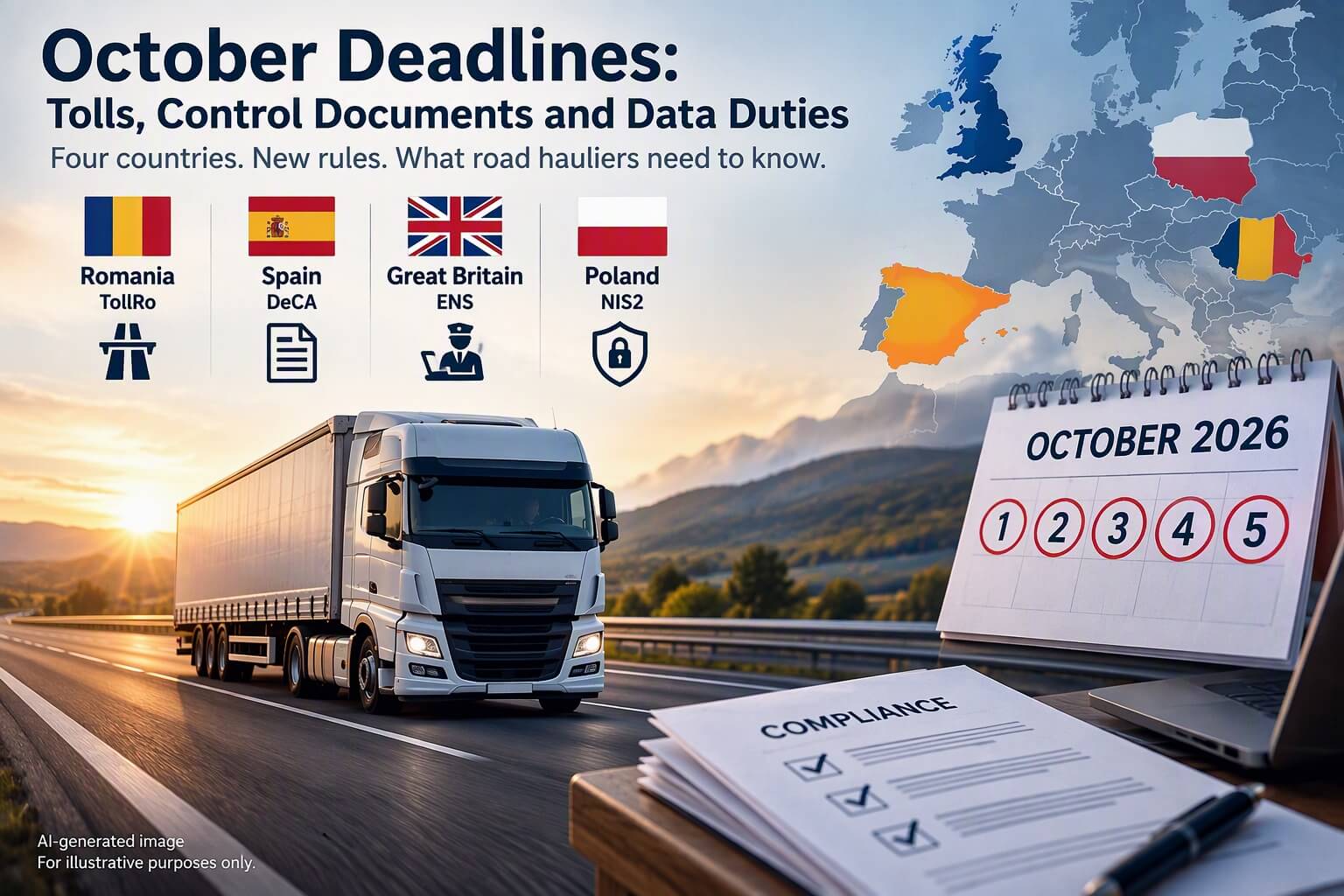
Four deadlines fall within the first five days of October 2026. Romania now charges heavy goods vehicles by the kilometre, Spain abolishes the paper control document, Great Britain has ended its grace period for faulty entry summary declarations, and Poland's NIS2 registration window has closed. None of these measures restricts where or when a lorry may drive. Each changes what an operator pays, carries or declares.
Romania: TollRo starts with a penalty freeze
Since 00:00 on 1 October, goods vehicles above 3.5 tonnes maximum authorised mass no longer buy the rovinietă. They pay TollRo per kilometre on motorways, expressways and national roads, graded by weight band, Euro class and road category. A Euro VI truck of 12 tonnes or more pays RON 0.48 per km on motorways and RON 0.24 on national roads.
The platform failed within hours of the launch: account creation, confirmations and card payments broke down, and CNAIR responded by announcing that users who could not pay would not be sanctioned until the faults had been fixed. That evening the acting transport minister, Radu Miruță, signed an order barring penalties where the application malfunctions.
The order protects operators who tried to pay and could not; the charge itself remains due. Unexpired truck vignettes lapsed at midnight and are refunded on application. EETS interoperability is expected from January 2027. Where the distance driven cannot be established, the law fixes the charge at RON 2,000.
Spain: the control document goes electronic on 5 October
From 5 October, the control document required for public road haulage within Spain exists only in electronic form, as the DeCA. It applies to domestic carriage and to cabotage. A cross-border journey that merely starts, ends or transits in Spain does not need one, and own-account transport falls outside the rule.
A resolution of 5 June 2026 sets the technical rules. The file is a PDF of at most 5 MB with a unique URL and QR code and must be generated before the service starts. The driver carries a digital or printed copy and may show the QR code alone at a roadside check. A change of vehicle, route or driver en route requires an amended or new file.
No state platform is prescribed, and an electronic consignment note may serve as the DeCA if it carries all the prescribed data.
Great Britain: ENS errors now carry consequences
Nothing new has to be filed. Safety and security declarations for goods entering Great Britain from the EU have been required since January 2025. What changed is enforcement: Border Force gave operators until 30 September to correct systematic errors, and since 1 October discrepancies can lead to correction requests and customs penalties.
Most errors concern the field identifying the means of transport, where accompanied Ro-Ro and Eurotunnel movements require the vehicle's registration number rather than a generic entry such as "truck" or the trailer number. Unaccompanied Ro-Ro needs the vessel's IMO number, and a container on a trailer is declared by its container number. If the vehicle is swapped before the border, the declaration has to be amended before arrival, and where an agent files on the carrier's behalf, the legal liability for ensuring that a declaration is lodged remains with the carrier.
Poland: the NIS2 registration window has closed
Poland's amended National Cybersecurity System Act, implementing the NIS2 Directive, entered into force on 3 April 2026 and gave essential and important entities six months, until 3 October, to identify themselves and apply for registration. The substantive duties follow by 3 April 2027, and fines reach EUR 10 million or 2% of annual turnover for essential entities, with lower ceilings for important entities.
In road transport, the directive names road authorities with traffic management functions and operators of intelligent transport systems. A haulier or forwarder is not covered merely because it moves goods. For most carriers the effect arrives by contract, as regulated customers pass supply-chain security requirements on to subcontractors and their IT providers.
The European frame: national rules on EU foundations
Romania is among the latest Member States to replace time-based charging for heavy goods vehicles with a distance-based model, reflecting the "user pays" and "polluter pays" principles embedded in Directive (EU) 2022/362. The directive goes beyond a general preference: subject to derogations, it bars time-based user charges for heavy-duty vehicles on the core TEN-T network from 25 March 2030 and requires charges to be varied by CO2 emissions. The Romanian switch, however troubled its start, therefore comes ahead of a deadline that the remaining vignette countries still have to meet.
Spain's DeCA runs ahead of the eFTI Regulation (EU) 2020/1056, under which every enforcement authority must accept electronic freight information shared through certified platforms from 9 July 2027; whether the national file and the eFTI platforms will connect, or leave operators entering the same data twice, is not yet settled. The British ENS regime has been domestic law since Brexit and mirrors the EU's ICS2 pre-arrival system without implementing it, while NIS2 is the only one of the four measures harmonised in substance at EU level, so that national differences arise mainly in scope and registration procedure.
Of the four developments, Romania is likely to generate the most immediate compliance and operational questions. How long the penalty freeze lasts, and how narrowly the authorities interpret "malfunction" once the platform stabilises, may determine whether the first month of TollRo becomes an administrative inconvenience or a significant compliance risk.
IETL members will find the full analysis, with the legal sources for all four jurisdictions and a country-by-country comparison, in the members' area.