News
Poland’s new driver CPC rules: Twelve hours online, and training in languages other than Polish
Poland’s new driver CPC rules: twelve hours online and training in languages other than Polish
Polish driver training has run under a new regulation since 3 November 2026. Signed on 7 October and published in the Dziennik Ustaw on 19 October as item 1355, it replaces the regulation of 2022. Much of the old text carries over, but three changes matter to carriers whose drivers hold a Polish code 95.
Twelve of 35 hours online
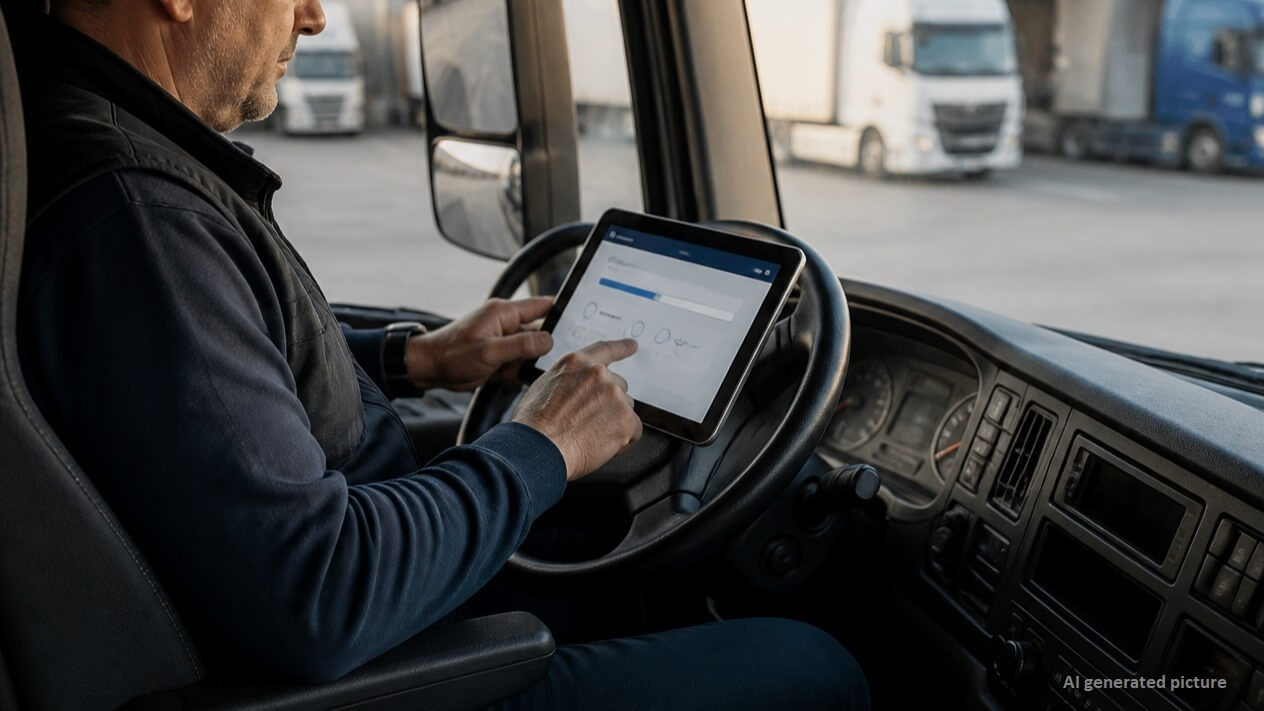
Periodic training comes first. Under Directive (EU) 2022/2561, lorry and bus drivers complete 35 hours every five years in units of at least seven hours, and up to 12 of those hours may be done by e-learning. Poland had allowed only seven, a single theoretical module (Section 17(5) of the 2022 regulation). Section 18(6) of the new regulation now permits all 12, spread over two theoretical modules. For drivers on long rotations, most of a second training day can therefore move out of the classroom. The other 23 hours still require attendance, and practical content stays offline.
Initial qualification is untouched. As before, the basic part of the 280-hour course, and of its 140-hour accelerated variant, may be taught remotely. The specialist part and the 20 or 10 hours of individual driving may not.
No more phone codes at login.
Identity checks are the second change. Under the 2022 regulation, trainees received a one-time code on their phone at every login and had to take classes in a fixed order. Section 18(3) drops both requirements. What is left is an individual identifier (PESEL or driver profile number), a password changed after the first login, time-stamped module records, a block on fast-forwarding, and a knowledge test after each module that must be passed before the course continues. The Directive asks only for ‘reliable user identification and control’ and leaves the means to Member States. Whether a login and password are enough is for the supervising voivodes to assess. Either way, other Member States must recognize the resulting code 95 under Article 10.
Training in the driver’s language
The third change concerns language. Section 18(9) allows training in a language other than Polish, provided the full program is taught, its objectives are met, and the trainees understand the content. The 2022 regulation had nothing comparable. Its only language rule allowed a sworn translator at the test, and the test itself is unchanged. It has 20 basic and 10 specialist questions, lasts 45 minutes, and is passed with 16 and 5 correct answers, respectively, on a computer at the regional road traffic center (WORD). Candidates who do not speak Polish may still bring a sworn translator or take the test without one if WORD offers it in a language they understand.
Read with Article 9 of the Directive, the clause reaches beyond Poland. Third-country nationals take their initial qualification where the employer is established or the work permit was issued, and their periodic training where they live or work. Polish carriers can therefore have drivers from outside the EU trained in a language they understand. According to the carriers’ association TLP, which analyzed inspectorate data, 146,090 driver attestations were valid in Poland at the end of July 2026, most of them held by Ukrainian and Belarusian nationals. Germany has so far changed only the test. Since 18 August 2026, candidates for the accelerated initial qualification can sit in nine languages besides German.
Credits, providers, and fees
Dangerous goods (ADR) training still counts for 14 hours of periodic training, or animal transport training for 7, but not both. The branch skills centres (branżowe centra umiejętności) created by the Act of 17 October 2025 now sit alongside commercial training centres as providers. Fees stay at 50 złoty for the test and 400 złoty for entry in the register of training providers, and training centers have six months to adapt their execution plans.
Points for practice
Carriers recruiting third-country drivers in Poland would do well to document the language of instruction for each course. Comprehension is the condition in Section 18(9), and a supervisory authority may later examine it as a question of fact. On identification, Poland now asks less than Austria or the Netherlands. Austrian guidance mentions webcam checks and regular attendance prompts, and the Dutch CBR framework favors multi-factor authentication.