
News
The Bike That Becomes a Moped: Why Austria's New E-Moped Rules Matter Across Europe
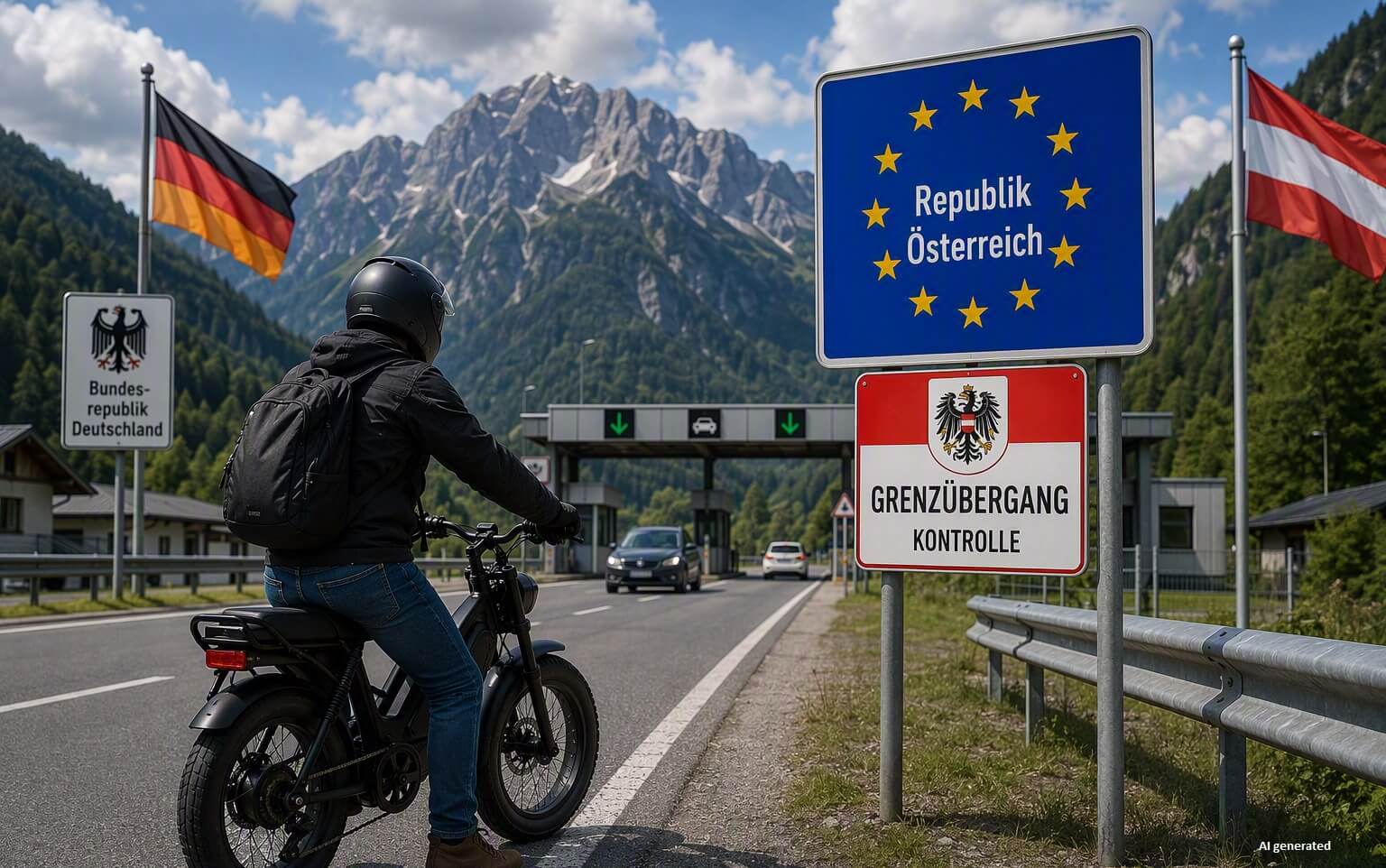
A driver crosses from Germany into Austria on an electric two-wheeler that has never needed a number plate, insurance or a driving licence at home. From 1 October 2026, the same machine may need all three in Austria too — not because anything about the vehicle changed, but because Austria has just closed a gap that most of its neighbours closed years ago.
Under Austria's 36th StVO amendment, electric two-wheelers whose motor can move the vehicle without pedalling — through a throttle grip or lever — are no longer classified as bicycles once their seat height sits above 540 millimetres. They fall instead into EU vehicle class L1e-B, the same category as a conventional moped, and this applies however the vehicle is registered elsewhere. What follows is the full moped rulebook: a driving licence, registration and a number plate, liability insurance, periodic inspection, a helmet, and no more use of bike lanes.
What makes this less a national quirk than it first appears is that Austria was late, not early. Germany has required registration, insurance and an AM licence for throttle-capable e-bikes above 25 km/h since its S-Pedelec rules were introduced years ago. The Netherlands treats the same category as a bromfiets, with a yellow plate and compulsory insurance — and is now, in late 2026, working through a further reform that would add a helmet requirement for under-18s on e-bikes and fat-bikes generally, after a documented rise in emergency-room visits among teenagers. Belgium, France, Switzerland, Spain and the United Kingdom all draw a broadly similar line, even if the exact wattage and speed thresholds are not identical from one to the next. Italy already applies its own version of the rule and is discussing tightening it further. Austria's reform brings it into line with a European norm that was already the majority position — which does not make the transition for 20,000 existing Austrian owners any less abrupt, but does mean the direction of travel was never really in doubt.
The one thing to note for anyone riding or operating this vehicle class across borders: "throttle e-bike" is not a single, harmonised category. The wattage cutoff, the exact speed threshold, and whether continuous pedalling is required to keep the motor engaged, vary by country. A machine built to satisfy one country's definition of a bicycle can still fail another's — which is exactly the trap the Austrian reform illustrates, just with Austria now on the stricter side of that line rather than the more permissive one.
Spain, in the meantime, is having the opposite experience on an entirely different question: a reform that keeps failing to happen.
Spain currently allows up to 0.5 grams of alcohol per litre of blood (0.25 mg/l in breath) for ordinary drivers, and a stricter 0.3 g/l for drivers in their first two years and for professional drivers. A government-backed bill to cut the general limit to 0.2 g/l — close to zero tolerance — was put to the Congress's Interior Committee on 18 March 2026 and lost, 19 votes to 18, with the conservative Partido Popular, the right-wing Vox, the Catalan ERC and the Navarrese regionalist UPN voting it down. In September 2026 the governing Socialists registered a fresh attempt, this time as a parliamentary bill rather than a government proposal. As of this writing it has not been put to a vote, and there is no date anywhere in the official record for a lower Spanish limit taking effect.
Spain's limit sits in the middle of a European field that varies more than most drivers assume.
Poland, Sweden and Norway already apply a general limit of around 0.2 per mille — the level Spain's failed bill was aiming for. The Czech Republic, Hungary, Romania and Slovakia enforce a general 0.0 limit. Germany, France, the Netherlands, Belgium, Austria, Switzerland, Italy, Croatia and Slovenia sit, like Spain, at 0.5. England, Wales and Northern Ireland allow the highest reading in western Europe, 0.8, while Scotland applies 0.5. None of this is converging: the one EU-wide step actually landing in 2026 does not touch the limit at all. From 7 July 2026, under the EU's General Safety Regulation, every newly registered car sold in the EU must carry a standardised interface for an alcohol interlock — the hardware connection, not an active device requiring a breath test to start the engine. It is a harmonisation of the plug, not of the rule about how much a driver is allowed to have had before using it.
Two very different stories, one shared rule underneath: for a driver, or for an operator running vehicles or riders across borders, the law that applies is always the law of the road currently under the wheels — not the law of the country where the vehicle was bought, registered, or where the driver learned to drive. Austria's reform and Spain's stalled one are, from that angle, the same lesson told twice.