
News
The cheap driving licence – and where Europe draws the line
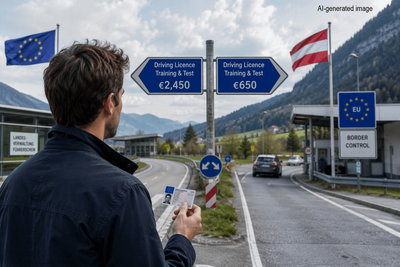
The driving licence has become an increasingly expensive commodity across Europe, and the disparity in training and examination costs between Member States remains striking. Unsurprisingly, more and more people, and not a few employers, are considering whether it might be worth travelling to a cheaper EU country to obtain one. The attraction is simple arbitrage. The rules governing such a cross-border move are not. They are precise, and they are strictly enforced.
The residence principle: the rule that deflates the saving
Under EU law, a driving licence must be issued by the Member State in which the applicant actually lives. “Normal residence” means the place where a person usually resides for at least 185 days in each calendar year because of personal and occupational ties (Article 12 of Directive 2006/126/EC). The only alternative qualifying link is evidence of studies lasting at least six months in that Member State (Article 7(1)(e)); mere attendance at a university or school does not, by itself, transfer normal residence. Without a genuine centre of life in the neighbouring country, a residence document alone will generally not satisfy the EU residence requirement.
The same rule, twenty-seven ways of applying it
Every Member State operates under the same Directive. In practice, however, recognition, exchange and enforcement are handled differently from one jurisdiction to another. Questions such as which licences are valid without formality, when exchange becomes mandatory, and how rigorously the residence requirement is scrutinised are matters of national administration. That is where most of the surprises await.
Acquisition is not recognition
A crucial distinction exists between obtaining a licence abroad and having it recognised at home. Anyone who lawfully acquires a driving licence in another Member State, based on genuine residence, may drive on that licence throughout the Union without conversion. That is one of the practical expressions of free movement, and it remains firmly protected.
What EU law does not permit, however, is licence tourism: using a foreign driving test to circumvent a driving ban, penalty points, or a fitness-to-drive requirement imposed by the home State. The Court of Justice has consistently held that a Member State may refuse recognition where it is established, either from the licence itself or from incontestable information supplied by the issuing State, that the residence condition was not met (Wiedemann and Funk, C-329/06 and C-343/06).
A person who is banned from driving, carries points, or faces a medical-psychological assessment at home cannot escape those consequences simply by crossing a border and taking another driving test. Online offers promising an instant foreign licence “without a test or a medical assessment” typically rely on precisely this misconception. Where such arrangements rest on nothing more than a paper address, the licence is unlikely to withstand scrutiny at home, and the customer is often left defrauded as well.
The net is tightening
The 2025 reform reinforces that trend. Directive (EU) 2025/2205 establishes the new driving-licence framework, introducing an EU-wide digital licence, modernising examination requirements and updating medical-fitness standards, while repealing the 2006 Directive. Its companion measure, Directive (EU) 2025/2206, creates a system for the cross-border enforcement of driving disqualifications, enabling a ban imposed in one Member State to take effect across the Union.
Both measures entered into force on 25 November 2025. Their practical significance is straightforward: as authority-to-authority data exchange becomes increasingly seamless, inconsistent residence histories, unresolved disqualifications and similar attempts to exploit administrative gaps become progressively easier to detect. The space in which licence tourism once operated continues to shrink.
The bottom line
The arithmetic is simple. Obtaining a driving licence in a cheaper EU country may reduce the upfront cost. Without genuine residence, however, the legal foundation is fragile. As administrative cooperation becomes more comprehensive and more digital, only a genuine relocation is likely to withstand scrutiny in the long term.
For members
The treatment of EU and non-EU driving licences differs significantly across Europe. Recognition rules, exchange obligations and the practical pitfalls of licence tourism vary from one jurisdiction to another. Our members’ briefing examines the country-specific regimes of selected jurisdictions, analyses the leading Court of Justice case law, and explains what the 2025 reform means for drivers, employers and fleet operators active across the continent.